On this page 13 sections
- What the research says
- Why speed matters so much
- How to answer in minutes, realistically
- First replies that answer the question
- What a good first reply includes
- Covering evenings and weekends
- What happens after the first reply
- What "fast" means in different businesses
- Why first replies fail
- A simple team process
- Automating the part after the first reply
- If you're a team of one
- Measuring it
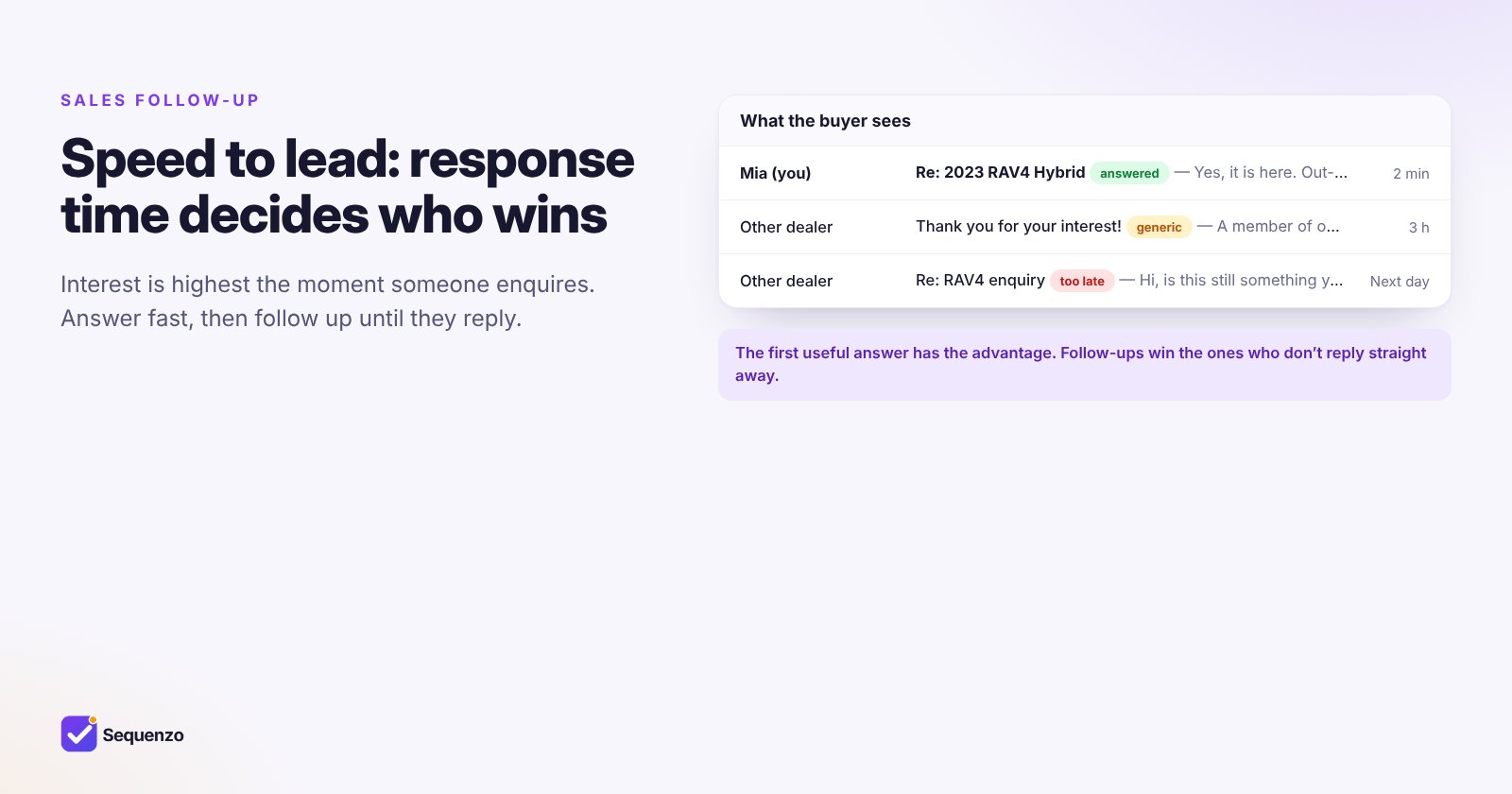
"Speed to lead" is the time between someone sending you an enquiry and getting a real answer. It's one of the few things in sales you fully control, and a lot of businesses still neglect it. A buyer who fills in a form on your website, a property portal or a car marketplace is interested right now. A few hours later they are interested in whoever answered first.
What the research says
The best-known study on this is "The Short Life of Online Sales Leads", published in Harvard Business Review in 2011 by James Oldroyd, Kristina McElheran and David Elkington. They audited how quickly companies responded to web leads, and their conclusion was blunt: "most companies are not responding nearly fast enough."
You'll see plenty of specific multipliers quoted from that research online. We haven't repeated them here, because the full figures sit behind HBR's paywall and we couldn't check them against the original. The general point isn't in doubt, though, and anyone who has handled inbound leads will recognise it. Interest fades quickly, and whoever gives the first useful answer has a big head start.
Why speed matters so much
- People enquire in more than one place. Buyers contact several agents, dealers or suppliers at once.
- Interest peaks when they enquire. They're at their desk or on their phone, thinking about this one thing.
- A fast, specific reply gives them a preview of how you'll treat them as a customer.
How to answer in minutes, realistically
- Route leads to a person, not a shared inbox nobody owns. Every lead needs one named owner.
- Get alerts where you work. A push or email alert for every new lead, during working hours.
- Prepare answers to the top five questions (availability, price, viewing or test-drive times, what's included, next steps) so a reply takes a minute instead of ten. Personalise the first line.
- Answer the question they asked. A fast reply that dodges the question is worse than a slightly slower one that answers it.
- Be honest outside working hours. An instant auto-reply that says when a real person will answer is fine. Pretending a machine is a person isn't.
First replies that answer the question
A fast reply only helps if it's useful. Here are first replies for common enquiries. Each one answers the question, offers a next step, and comes from a named person.
"Is it still available?" (property)
"Hi Priya, yes, the flat on Park Road is still available. I have viewing slots on Thursday at 6:30pm and Saturday at 10am. Would either suit you? Jordan"
"What's your best price?" (car)
"Hi Chris, the RAV4 is on the lot. I can send you the out-the-door price with taxes and fees for your zip code. Which zip should I use? Mia"
"Can you quote for this?" (services)
"Hi Dana, thanks for the details. I can give you a firm quote after a 20-minute site visit. Are Tuesday or Wednesday mornings possible? In the meantime, similar jobs have usually come in between $X and $Y."
Website contact form (B2B)
"Hi Sam, thanks for getting in touch. To point you to the right thing: are you looking at this for yourself or for a team, and roughly when would you want to start? I'm free for a 15-minute call tomorrow if that's easier."
What a good first reply includes
- The answer to the question they asked, in the first line.
- One next step, with a real time or a simple question.
- Your name, so they know a person is dealing with it.
- Nothing they have to download or log in to before they can reply.
Covering evenings and weekends
Many enquiries arrive outside office hours. You have three honest options. You can rota someone to answer within a couple of hours, send an automatic reply that says when a person will respond and what happens next, or route weekend leads to whoever is working in the showroom or office. What doesn't work is a vague "we'll be in touch" and then nothing until Tuesday.
What happens after the first reply
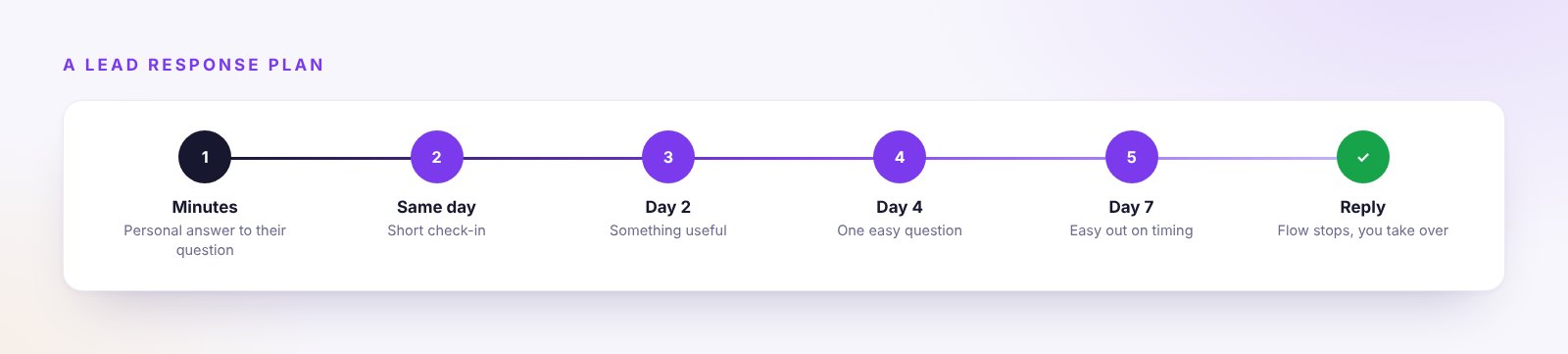
Responding fast gets you into the conversation. But many leads won't reply to your first answer. They got busy, they're comparing, or they're not ready yet. A lot of business is won or lost at this point, and it's where many teams give up after one email.
A short, polite follow-up sequence helps here: a same-day or next-day check, then a few messages over the following days that each add something new, then a polite close. See how long to wait before a follow-up and the follow-up cadence playbook.
For industry-specific plans, read the 90-day real estate lead plan and the first 72 hours of a dealership internet lead.
What "fast" means in different businesses
The right target depends on how buyers shop. Someone enquiring about a car or a rental flat is usually contacting several businesses at once, so minutes matter. A company asking for a software proposal is slower to decide, but the first useful answer still tends to set the tone for the rest of the conversation. As a rough guide:
| Type of enquiry | Aim to reply within | Why |
|---|---|---|
| Car or property portal lead | 15 minutes in working hours | Buyers enquire with several dealers or agents at once |
| Quote request for a local service | 1 hour | Homeowners usually ask two or three businesses |
| Website form for a B2B product | Same working day | A considered decision, but the first answer shapes it |
| Referral or repeat customer | Same day | They expect to be remembered |
These are working targets, not research findings. Measure your own response time for a month, then set a target you can meet every day.
Why first replies fail
- The enquiry lands in a shared inbox that nobody owns, so everybody assumes somebody else has it.
- The first reply is an automated "thanks for your interest" that answers nothing, so the buyer keeps shopping.
- The reply asks the buyer to call instead of answering their question by email.
- Nobody follows up when the buyer doesn't answer the first reply.
A simple team process
- Every enquiry source (website form, portals, marketplaces, phone messages) goes to one place, with a named owner assigned straight away.
- The owner gets an alert on their phone during working hours.
- The first reply is written by a person, using a saved answer to the common question and a personal first line.
- When the first reply goes out, a follow-up flow is attached, so the silence afterwards is handled.
- Once a week, someone checks the numbers below and looks at any lead that waited more than an hour.
Automating the part after the first reply
Speed to lead is mostly about the first reply, and that should come from a person. The follow-ups afterwards are where automation helps, because they need to happen on time for every lead, including the ones that arrive on a busy Friday afternoon. Attach a short flow when you send the first reply: a check the next day, something useful a few days later, and a polite close. If the lead answers at any point, the flow stops and the conversation is yours.
If you're a team of one
Solo agents, brokers and contractors can't answer every enquiry in fifteen minutes. Set a realistic promise, such as "within two hours during the working day", turn on alerts only for new enquiries, and keep three or four saved replies for your most common questions so answering takes a minute from your phone. Then let the follow-ups run on their own so you only need to step in when someone replies.
Measuring it
- Median time to first reply during working hours.
- Percentage of leads that got a follow-up when they didn't answer the first reply. In many teams this is the bigger gap.
- Reply rate and meetings or viewings booked. Opens are too unreliable to count.
Sequenzo handles the second half of speed to lead. You send the first answer yourself from Gmail or Outlook, pick a follow-up flow in the compose window, and the follow-ups go out on schedule from your own mailbox until the lead replies. See how to set it up.
Frequently asked questions
Q01What is speed to lead?
It is the time between a prospect sending an enquiry and receiving a real, useful response from your business. Shorter is better, because people are most interested right when they enquire.
Q02How fast should you respond to a new lead?
As fast as you realistically can during working hours, ideally within minutes. Research such as the 2011 Harvard Business Review study "The Short Life of Online Sales Leads" found most companies respond far too slowly.
Q03Is an automatic reply good enough?
An honest auto-reply saying when a person will answer is fine outside working hours, but it does not replace a real answer to the person's question.
Q04What should happen if the lead doesn't reply?
Follow up. A few short, useful follow-ups over the following days recover many leads that did not answer the first time. Stop as soon as they reply.