On this page 10 sections
Most people who ask for an insurance quote don't say no. They say nothing. The quote sits in their inbox next to two others, the renewal date is still a few weeks away, and the decision feels like something to deal with later. Later often turns into the day before the old policy lapses, when they renew with whoever is easiest.
This guide covers how to follow up on insurance quotes, renewals and policy reviews without sounding like a sales script. There's a timing table for each situation, ten templates you can adapt, and notes on staying within the rules.
This guide is for independent insurance agents, brokers and small agencies following up with people who asked for a quote or already hold a policy with them. It isn't about cold prospecting, which is more tightly regulated in most countries. Nothing here is legal or compliance advice; check your regulator's rules on communications.
Why insurance quotes go quiet
- The client is comparing your quote with others and doesn't understand the differences, so they default to the cheapest.
- The renewal date feels far away, so there's no reason to decide today.
- They aren't sure what the excess, exclusions or limits mean, and they don't want to look foolish by asking.
- Someone else in the household or business has a say.
- Your email slid down a busy inbox.
Good follow-ups deal with these one at a time: explain the cover, mention timing only when it's real, and make it easy to ask a question.
The timing at a glance
| Situation | First follow-up | Then | Stop |
|---|---|---|---|
| New quote | Day 2 | Day 6, day 12 | After the quote expires, with a close-the-loop email |
| Renewal | 4 to 6 weeks before the date | 3 weeks, 1 week, 2 days before | When they renew or tell you they've moved |
| Annual review | A month before the anniversary | One reminder 2 weeks later | After the review or a clear "no changes" |
| Missing documents to bind cover | Day 1 | Every 2 days | When everything arrives |
Ten insurance follow-up templates
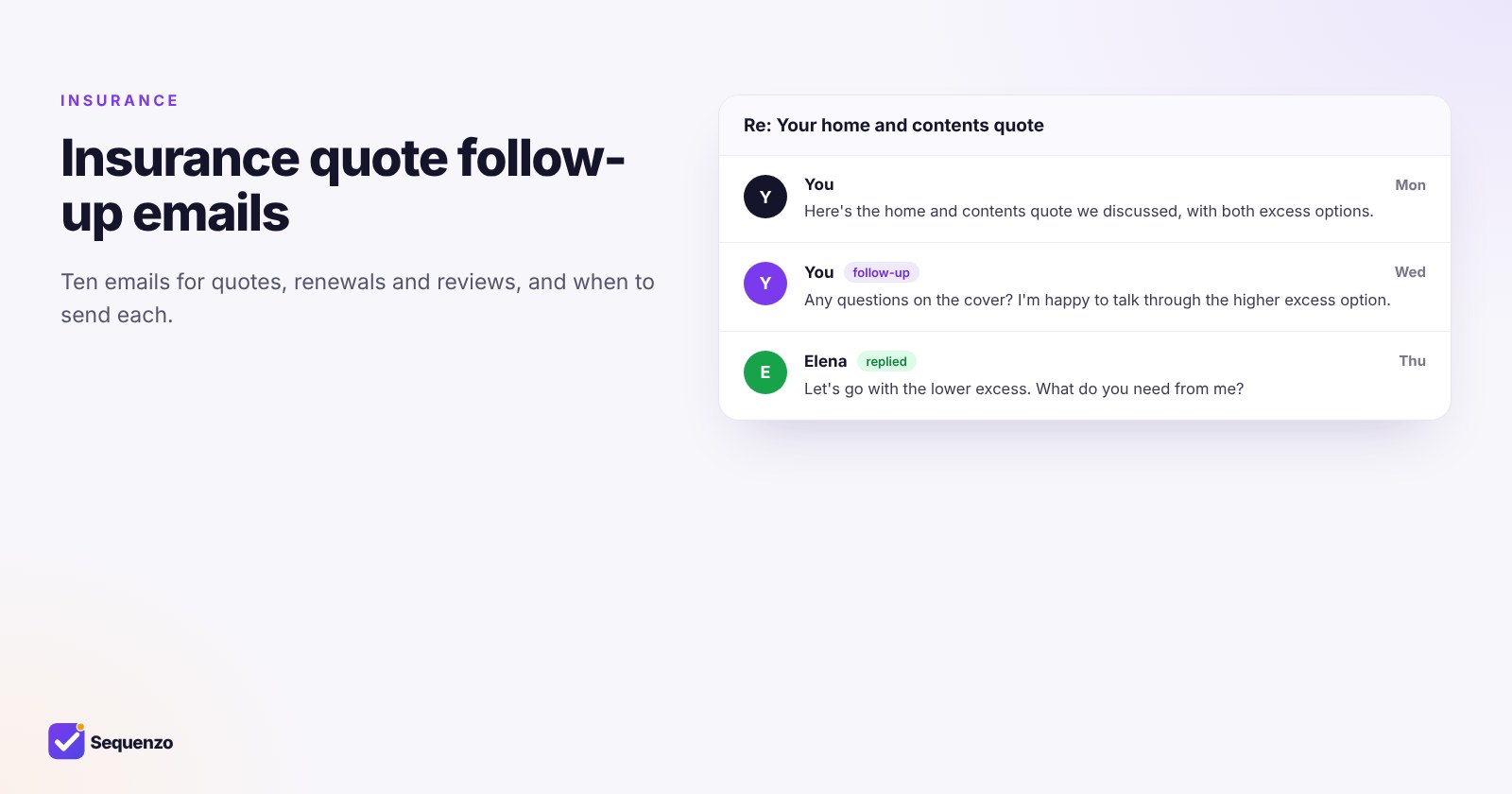
1. After sending a quote (day 2)
"Hi Elena, did the home and contents quote come through OK? I've put the two excess options side by side in the PDF. If anything's unclear, reply here and I'll explain it in plain English."
2. Explain the difference (day 6)
"Elena, one thing people often ask when comparing quotes: ours includes accidental damage and new-for-old replacement, which some cheaper policies leave out. If you have another quote, send it over and I'll tell you how they compare."
Clients who compare on price alone often haven't noticed what's missing. Pointing it out is useful, as long as you're accurate about the other policy.
3. The real deadline (day 12)
"A quick reminder that this quote is held until the 30th. If you want cover to start on a particular date, let me know and I'll make sure there's no gap."
4. Close the loop
"I'll close this quote for now so I'm not filling your inbox. If you'd like to pick it up again, reply and I'll refresh the figures."
5. Renewal, six weeks out
"Hi Sam, your van insurance renews on 14 March. Before then, it's worth checking a few things: has your annual mileage changed, are there new drivers, and have you added any equipment? Reply with any changes and I'll check the renewal price against the market."
6. Renewal, one week out
"Sam, your policy renews in a week. I've attached the renewal terms. If you're happy, there's nothing to do. If you'd like me to look for a better price, reply today so I have time."
7. Annual review
"Hi Priya, it's a year since we set up your business insurance. Have there been changes, such as new staff, new premises, or bigger contracts, that might mean the cover needs updating? A 15-minute call is usually enough."
8. Life changes
"Congratulations on the new house, Alex. When you have a moment, let's update your contents cover and check the buildings policy is in place from completion day. What date do you get the keys?"
9. Missing documents
"Hi Elena, to put the cover in place I just need a copy of your no-claims letter from your previous insurer. A photo from your phone is fine."
10. After a claim
"Hi Sam, I wanted to check how the claim is going and whether there's anything you're waiting on. If the insurer is slow to respond, tell me and I'll chase them for you."
Following up on a claim isn't a sales email, but clients remember who helped when something went wrong. It's often why they renew with you.
Explain cover in plain English
Most quote follow-ups fail because they repeat the price. Clients reply when you help them understand what they're buying. Three things are worth explaining in almost every case: the excess (the deductible, in the US) and what it means in practice ("if you claim for a $600 repair, you'd pay the first $250"), the main exclusions, and anything that would make a claim more likely to be refused. Keep it short, and offer a call for anything complicated.
Staying compliant
- Only follow up with people who asked for a quote, hold a policy, or have agreed to hear from you.
- Be accurate. Don't overstate cover or misdescribe a competitor's policy.
- Include a clear way to opt out, and honour it straight away.
- Keep a record of what you sent. Automated follow-ups should be logged in your CRM like any other email. See logging follow-up emails with a BCC address.
- Check your regulator's rules on financial promotions and record keeping before you write templates.
For the general rules on commercial email, see follow-up emails and the law.
Renewal season without the chaos
When dozens of renewals fall in the same month, personal follow-up is the first thing to slip. Set up a renewal flow once: an email six weeks before the date, a reminder three weeks out, the renewal terms a week before, and a last check two days before. Start it for each client as their renewal approaches, and let it run. When a client replies, the flow stops and you handle the conversation yourself.
Commercial clients
Business insurance usually involves more people and more information: turnover, staff numbers, premises, contracts. Follow-ups should make it easy to collect what's missing. Send a short checklist, offer a call with whoever looks after the figures, and give a realistic timeline for the quote. For renewals, start earlier, often two to three months ahead, because changes in the business can take time to gather.
Measuring what works
Track how many quotes turn into policies, and how many renewals you keep. Compare clients who got the full follow-up sequence with those who didn't. Look at which emails get replies; in most agencies the "explain the difference" and "renewal checks" emails do the most work.
Common mistakes
- Sending the renewal the week before, with no earlier warning. The client has no time to ask questions, so they either renew without thinking or leave.
- Repeating the price in every follow-up. Explain the cover instead.
- Invented urgency, such as "prices rise tomorrow" when they don't.
- Following up after the client has told you they've moved elsewhere. Thank them, ask why, and stop.
Doing it from your own inbox
Sequenzo for insurance agents sends follow-ups like these from your own Gmail or Outlook mailbox, in the same thread as the quote or renewal, and stops when the client replies. Out-of-office replies pause the flow instead of stopping it, every email has a one-click opt-out, and auto-BCC keeps your CRM up to date. If you want to work out renewal dates or deadlines, the free business days calculator helps.
Frequently asked questions
Q01How soon should an insurance agent follow up on a quote?
About two days after sending it, then around day 6 and day 12. Space later follow-ups further apart and stop when the client replies or the quote expires.
Q02When should renewal follow-ups start?
Four to six weeks before the renewal date for personal lines, and earlier, often two to three months, for commercial clients.
Q03What should an insurance follow-up email say?
Explain the cover rather than repeating the price: the excess or deductible, the main exclusions and how the options differ. End with one easy question.
Q04Can I automate insurance follow-ups?
Yes, for clients who asked for a quote or hold a policy with you, as long as every email is accurate, includes a way to opt out, and is logged. Check your regulator's rules.