On this page 11 sections
- The invoice timing at a glance
- Make the first invoice email do the work
- Six invoice reminder templates
- Four proposal follow-ups
- Payment terms that prevent late payment
- Clients who always pay late
- When to stop emailing
- Clients in other countries
- Tone that gets paid
- Common mistakes
- Reminders that send themselves
Few jobs feel as awkward for agencies, consultants and freelancers as chasing an unpaid invoice. You did the work, the client was happy, and now you have to ask for money without sounding desperate or damaging the relationship. So the reminder gets put off, and the invoice drifts from 30 days to 60.
Most late invoices haven't been disputed. They're sitting in someone's inbox, waiting for an approval, or sent to the wrong person. A calm, regular series of reminders usually gets them paid. This guide gives you the timing, ten templates for invoices and proposals, and the point at which to stop emailing and pick up the phone.
This guide is for agencies, consultants, freelancers and small service businesses invoicing business clients. It isn't legal advice on debt recovery, late-payment interest or collections, which vary by country; check the rules where you and your client are based before you add interest or fees.
The invoice timing at a glance
| When | Tone | |
|---|---|---|
| Day 0 | The invoice | Thank you, due date, how to pay |
| 3 days before due | Friendly heads-up | Helpful |
| Due date | Due today | Neutral |
| Due + 5 days | Right person? | Practical |
| Due + 12 days | Overdue, when is it scheduled? | Firm and polite |
| Due + 20 days | Phone call, then a written summary | Direct |
Keep every reminder in the same thread as the original invoice, so the PDF and the history are always one scroll away.
Make the first invoice email do the work
A lot of chasing disappears if the invoice email is complete. Include the amount and due date in the body, not only in the PDF. Say how to pay, with bank details or a payment link. Include the purchase order number if the client uses them, and send it to the person who approves invoices as well as your day-to-day contact. The free invoice generator makes a tidy PDF if you don't have a template.
Six invoice reminder templates
1. The invoice
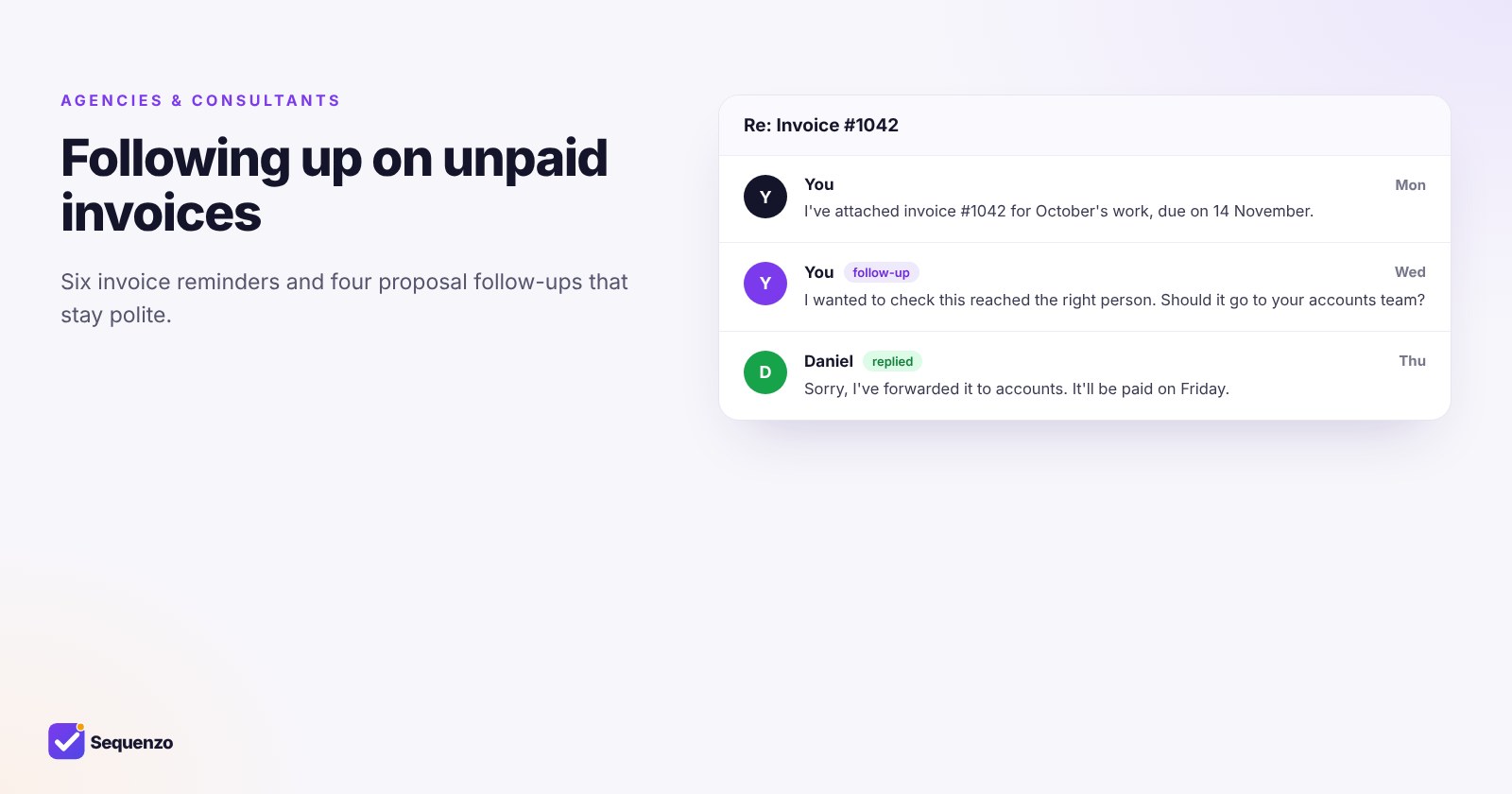
"Hi Daniel, I've attached invoice #1042 for October's work: $4,800, due on 14 November. Payment details are on the PDF. Thanks again, it was a good month."
2. Three days before it's due
"Hi Daniel, a quick heads-up that invoice #1042 is due on Friday. If it needs a purchase order or approval from someone else, let me know and I'll send whatever they need."
3. On the due date
"Hi Daniel, just a reminder that invoice #1042 is due today. The payment details are on the attached PDF."
4. Five days late: right person?
"I wanted to check this reached the right person. If it should go to your accounts team, could you forward it or send me their address?"
This is often the email that gets it paid, because it gives the client an easy, face-saving reason the payment was late.
5. Twelve days late
"This invoice is now 12 days overdue. Could you let me know when payment is scheduled? If anything on it is unclear or needs changing, I'm happy to help."
6. After a phone call
"Thanks for the call, Daniel. As agreed, payment of $4,800 will be made by Friday 28th. I'll look out for it."
Putting a promise in writing makes it more likely to happen, and gives you a clear record if it doesn't.
Four proposal follow-ups
Proposals stall for different reasons than invoices. Your contact likes the work but has to convince someone else, or the budget isn't confirmed yet.
7. Did it land? (day 2)
"Hi Daniel, did the proposal come through OK? If it would help, I can walk your team through it in 15 minutes."
8. Something to forward (day 5)
"In case it's useful for your internal discussion, here's a one-paragraph summary you can forward as it is: what we'd do, the cost, and the start date."
9. A smaller first step (day 9)
"If the full scope is a big decision right now, we could start with phase one only. It's about a third of the cost and gives you something to judge us on."
10. Close the loop (day 16)
"Should I keep this open, or is now not the right time? Either answer helps me plan."
For more wording, see how to follow up on a quote or proposal.
Payment terms that prevent late payment
The best way to chase less is to agree terms that make late payment less likely. For new clients, ask for a deposit before you start. For longer projects, invoice at milestones rather than at the end. Put the payment terms in the proposal and the contract, not only on the invoice, and say what happens if a payment is late, in line with local rules. Clients rarely object to terms they agreed to in advance.
Clients who always pay late
Some clients pay every invoice 20 days late, however nicely you ask. Talk to them about it once, calmly: is there a payment run you're missing, a purchase order you should include, or a different person to send invoices to? If nothing changes, build it into your terms or your price, or decide whether the client is worth keeping.
When to stop emailing
If an invoice is three weeks late and nobody has replied to any reminder, email has done what it can. Call your contact, or their accounts team, and ask directly when it will be paid. After the call, send a short written summary. If it still isn't paid, check your contract and local rules on late-payment interest and formal steps before you go further.
Clients in other countries
For international clients, say which currency the invoice is in, include the bank details they need for an international transfer, and allow a few extra days for the payment to arrive. If you offer card or online payment, mention it; it often gets paid faster than a bank transfer.
Tone that gets paid
- Stay factual. Amount, invoice number, due date, how to pay.
- Assume good faith until there's a reason not to.
- Ask practical questions: right person, purchase order, scheduled date.
- Write the reminders when you're calm, ideally before you need them.
Common mistakes
- Waiting until 30 days overdue to send the first reminder.
- A new email thread for every reminder, so nobody can find the invoice.
- Sarcasm or frustration in writing. It feels good for a minute and slows payment down.
- Continuing to work on new projects for a client with several unpaid invoices, without talking about it.
Reminders that send themselves
Sequenzo for agencies and consultants sends reminders like these from your own mailbox, in the same thread as the invoice, on the schedule you set. When the client replies, even with "paid today", the rest are cancelled. If they pay without replying, stop the flow for that contact with one click.
Frequently asked questions
Q01When should I send the first invoice reminder?
A friendly heads-up three days before the due date, then a reminder on the day. Most clients pay on time when they have both.
Q02What should an overdue invoice email say?
The invoice number, amount and due date, how to pay, and one practical question, such as whether it reached the right person or when payment is scheduled.
Q03When should I stop emailing and call?
If an invoice is about three weeks late and nobody has replied, call, then confirm what was agreed in writing.
Q04Can I add late-payment interest?
It depends on your contract and the law where you and your client are based. Check both before adding interest or fees.