On this page 11 sections
- Why applications stall
- The timing at a glance
- How to ask so people send things
- Nine templates
- Self-employed clients
- Keeping the client informed after submission
- Following up with solicitors, employers and other lenders
- Protecting client data
- Measuring what slows you down
- Common mistakes
- Doing it without a spreadsheet
Chasing documents is most brokers' least favourite job, and it decides how fast an application moves. The client wants the mortgage. They also have a job, children and a house move to organise, and finding three payslips falls to the bottom of the list. A clear, friendly email usually gets documents back faster than a phone call that goes to voicemail.
This guide covers how to ask for documents so people actually send them, how often to chase, and nine templates for document requests, applications that stall, and rate reviews.
This guide is for mortgage brokers, loan officers and advisers chasing documents and decisions from clients who have already asked for help. It doesn't cover marketing to new prospects, and nothing here is regulatory advice; check your regulator's rules on client communications and record keeping.
Why applications stall
- The request was vague. "Your documents" is a job nobody can start. "Your last three payslips" is.
- The client can't find something and is embarrassed to say so.
- They don't know a phone photo is acceptable, so they wait until they can get to a scanner.
- The first email arrived on a busy day and was never seen again.
- They're waiting on someone else: an employer, an accountant, a previous lender.
The timing at a glance
| Situation | First follow-up | Then | Stop or switch |
|---|---|---|---|
| Documents requested | Day 2 | Day 5, day 9 | Pause the application with a friendly note |
| Agreement in principle issued | Week 2 | Every 2 to 3 weeks | When they find a property or the AIP expires |
| First enquiry, no application | Day 1 | Day 4, day 10 | Close the loop at day 20 |
| Fixed rate ending | 6 months before | 4 months, 3 months, 6 weeks | When the new deal is in place |
Every two to three days is firm without being annoying for documents. Rate reviews run on a much slower clock, because the decision isn't urgent until the last few months.
How to ask so people send things
- List exactly what you need, one item per line. Repeat the list in every reminder.
- Say what format is fine. "A photo from your phone is fine" removes the most common delay.
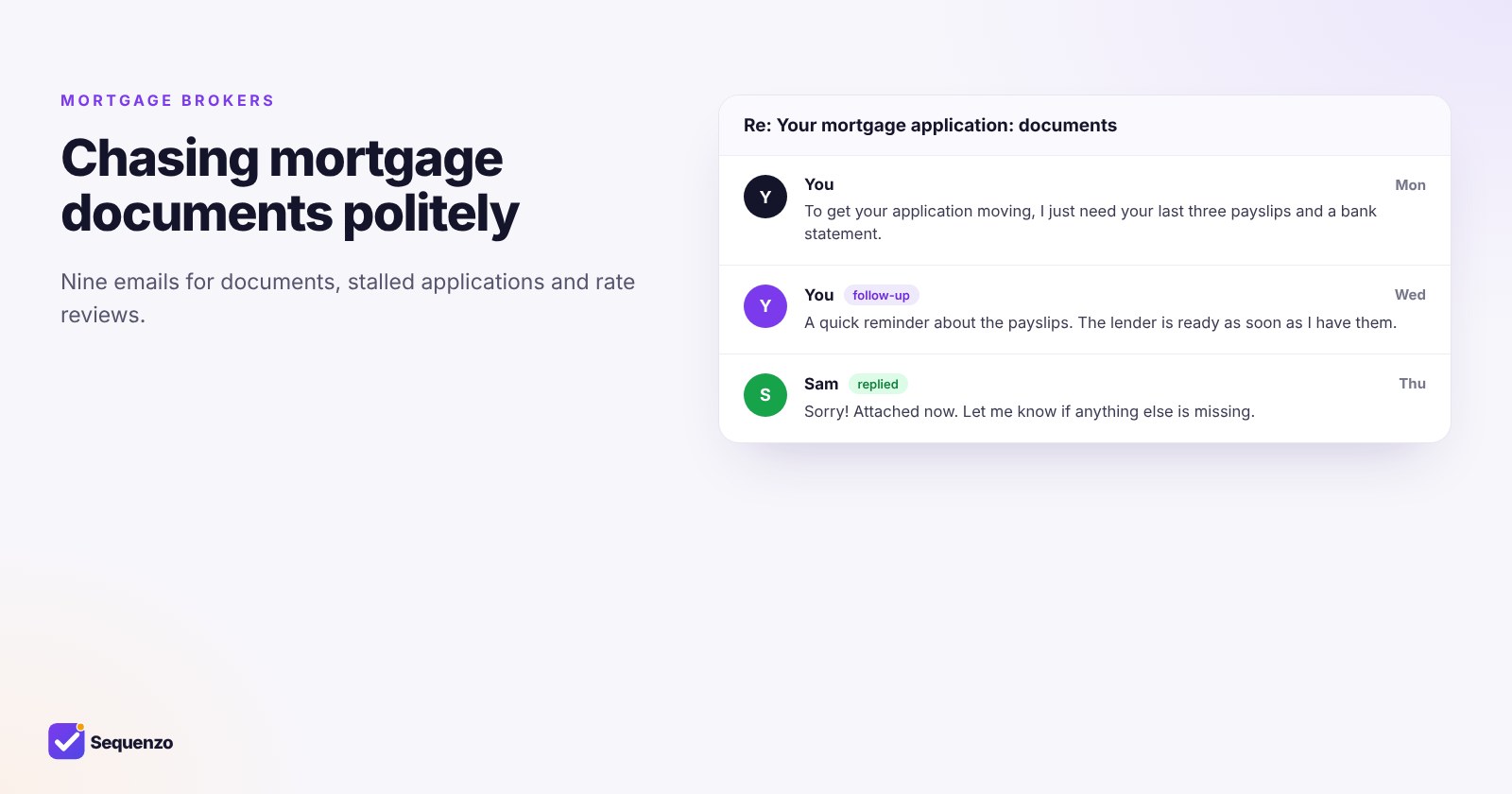
- Say why it matters, briefly: "The lender is ready as soon as I have these."
- Offer an alternative for anything hard to find, if the lender accepts one.
- Tell them what you already have, so they don't send it twice.
Nine templates
1. The first request
"Hi Sam, to get your application moving I need:
- your last three payslips
- your latest bank statement
- a photo of your driving licence
A photo from your phone is fine for all of them. Reply to this email with the attachments and I'll send everything to the lender."
2. First reminder (day 2)
"Hi Sam, a quick reminder about the payslips, bank statement and licence. As soon as I have them I can submit the application."
3. Make it easier (day 5)
"Just checking these haven't got buried. If the payslips are hard to find, your employer's payroll team can usually send copies, or the lender may accept your year-end tax statement alongside the latest one. Which is easier?"
4. Partly received
"Thanks, Sam, the bank statement and licence have arrived. I'm just waiting on the three payslips now, and then we're ready to go."
5. Pause the application (day 9)
"I'll pause the application for now so it doesn't expire. Reply whenever you're ready and we'll carry on from where we stopped."
6. Agreement in principle, checking in
"Hi Priya, how's the house hunt going? Your agreement in principle is valid until [date]. If you find somewhere before then, let me know and I'll move quickly on the full application."
7. First enquiry, no application yet
"Hi Alex, thanks for the call on Tuesday. As promised, here's a short list of what you'd need for an application. There's no rush; when you're ready, reply here and we'll start."
8. Fixed rate ending in six months
"Hi Jordan, your fixed rate ends in [month]. It's a good time to start looking at what comes next, because some lenders let you secure a new rate several months in advance. Would a 15-minute call in the next few weeks suit you?"
9. Fixed rate ending in six weeks
"Jordan, your current deal ends on [date]. If you haven't arranged anything, you'll move to the lender's standard rate, which is usually higher. I can review the options this week if you'd like."
Self-employed clients
Self-employed applicants usually need more documents and take longer to gather them. Send the full list early, explain why each item is needed, and offer to speak to their accountant directly if the client agrees. A template:
"Hi Grace, because you're self-employed, the lender will need your last two years' accounts or tax calculations, and the matching tax year overviews. If it's easier, I can ask your accountant for them directly. Would that help?"
Keeping the client informed after submission
Once an application is with the lender, clients often go quiet because they assume there's nothing to do, and then worry because they've heard nothing. A short update every few days helps: "Your application is with the underwriter. The valuation is booked for Tuesday. I'll let you know as soon as there's news." It also means they answer quickly when the lender does ask for something.
Following up with solicitors, employers and other lenders
Sometimes the delay isn't the client. A reference from an employer, a redemption statement from the current lender, or a solicitor's enquiry can hold things up for weeks. Keep these in separate threads, with the client copied only if it helps. The same rules apply: say exactly what you need, by when, and why.
Protecting client data
Mortgage documents contain some of the most sensitive data people have. Ask clients to send documents only to your business address, or through a secure upload if you have one. Don't forward them around unnecessarily, and delete copies you no longer need. Mailbox credentials used by any follow-up tool should be encrypted and revocable.
Measuring what slows you down
Note how many days each application waits for documents. Most brokers find the same few items cause most of the delay. Once you know which, mention them first in the initial request and explain alternatives straight away.
Common mistakes
- Asking for "your documents" without a list.
- Sending the full checklist again every time, including what's already arrived.
- Chasing every day. Every two or three days is enough.
- Leaving rate reviews until the last month, when the client has already been contacted by their current lender and several comparison sites.
Doing it without a spreadsheet
Sequenzo for mortgage brokers sends reminders like these from your own mailbox, in the same thread as the original request, and stops as soon as the client replies with the documents. Outlook and Microsoft 365 connect with Microsoft sign-in, and Gmail and IMAP mailboxes use an app password that is encrypted at rest. For timing reviews, the free business days calculator works out dates for you.
Frequently asked questions
Q01How often should a broker chase documents?
Every two to three days is firm without being annoying. After three or four reminders, pause the application with a friendly note.
Q02What makes clients send documents faster?
A specific list, permission to send phone photos, a short reason why it matters, and an alternative for anything hard to find.
Q03When should a remortgage review start?
Around six months before a fixed rate ends, with follow-ups at four months, three months and six weeks.
Q04Is it safe to receive mortgage documents by email?
Ask clients to send only to your business address or a secure upload, avoid forwarding documents unnecessarily, and delete copies you no longer need.