On this page 12 sections
- The timing at a glance
- Following up with candidates
- Following up with hiring managers
- References and right-to-work checks
- Candidates who said "maybe later"
- Why feedback delays cost hires
- Being honest with candidates
- Subject lines that work in recruiting
- Data and consent
- Measuring the process
- Common mistakes
- Keeping both sides moving
Recruiting runs on follow-up. Candidates have several processes going at once, hiring managers forget to give feedback, and offers sit unsigned while someone thinks it over. The recruiter who keeps every conversation moving, without becoming a nuisance to anyone, usually fills the role.
This guide covers follow-ups on both sides of the desk: candidates and hiring managers. There's a timing table, eleven templates, and notes on what to do when someone goes quiet at each stage.
This guide is for agency recruiters, in-house recruiters and hiring managers following up with candidates who have applied or agreed to be put forward, and with clients and colleagues who are part of a hiring process. It isn't about cold sourcing at scale, which has its own rules on data and consent.
The timing at a glance
| Stage | Who | Follow up | Why |
|---|---|---|---|
| Role sent to a candidate | Candidate | Day 1, day 3 | Interest fades quickly |
| Shortlist sent | Hiring manager | Day 2, day 4, day 8 | Good candidates are interviewing elsewhere |
| After an interview | Both | Within 48 hours | Delays here lose most candidates |
| Offer out | Candidate | Every 1 to 2 days until signed | Counter-offers and second thoughts |
| After a rejection | Candidate | Once, then in 3 months | Keep good people for the next role |
Following up with candidates
1. After sending a role
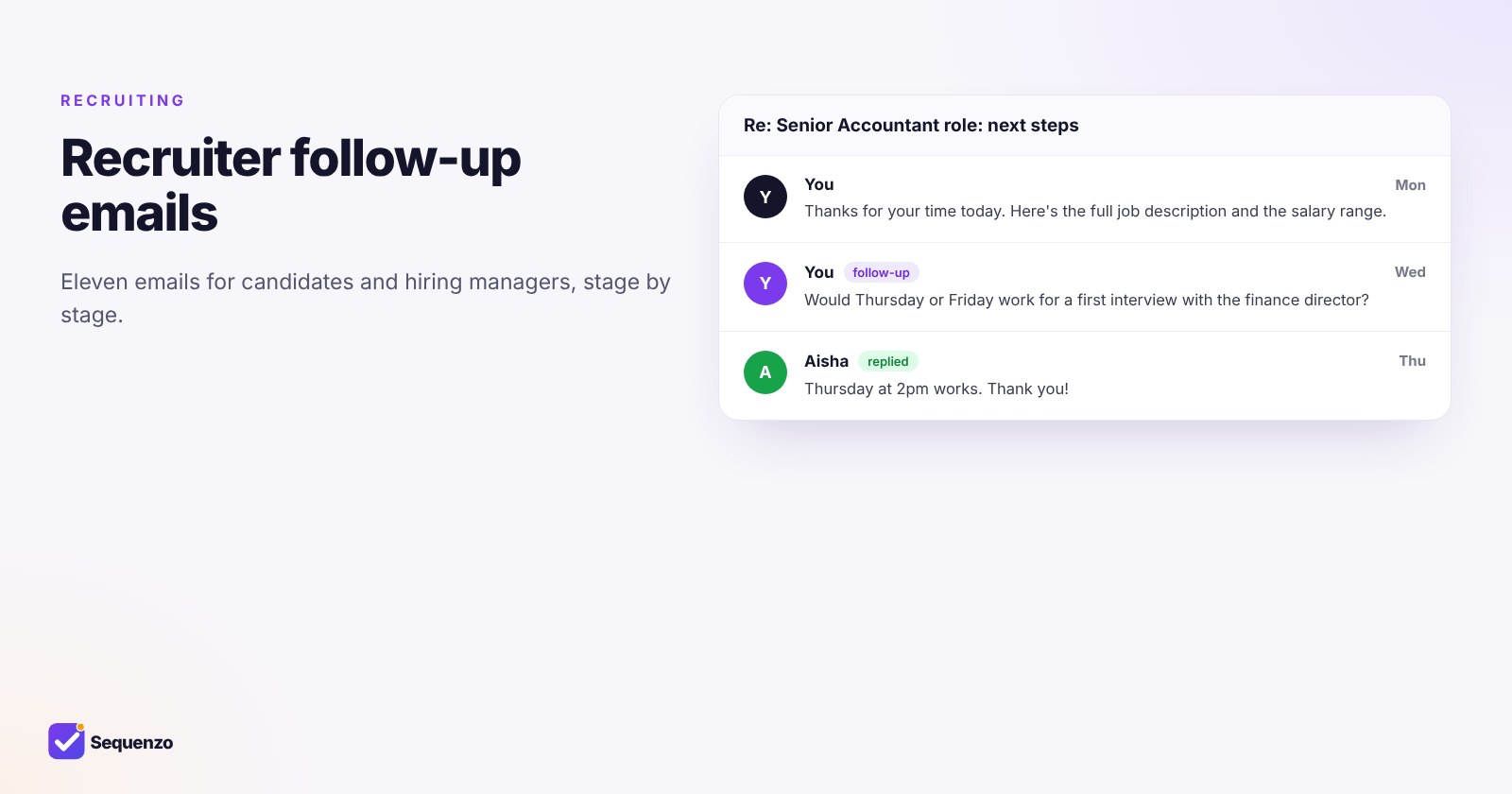
"Hi Aisha, thanks for your time today. Here's the full job description for the Senior Accountant role, with the salary range and hybrid policy. Does it look like a fit? If so, I'll put you forward this week."
2. Still interested? (day 3)
"Hi Aisha, did you get a chance to look at the role? If the salary or the commute doesn't work, tell me, and I'll keep an eye out for something that fits better."
3. Interview confirmation
"Great news: the finance director would like to meet you on Thursday at 2pm, at their office on King Street. I've attached a short note on who you'll meet and what they'll ask. Can you confirm?"
4. After the interview
"Hi Aisha, how did it go? I'll have their feedback by Thursday. In the meantime, is there anything you'd like me to find out about the role or the team?"
5. Offer out
"Congratulations again. The offer letter is attached. Is there anything in it you'd like me to check or negotiate before you sign? I'm free to talk this evening if that helps."
6. Not this time
"Hi Aisha, I'm sorry to say they've gone with another candidate who had more audit experience. Your interview went well, and I'd like to keep you in mind for similar roles. Is it OK if I get in touch when one comes up?"
Following up with hiring managers
7. Shortlist sent
"Hi Mark, here are the three strongest candidates for the role, with a short note on each. I'm happy to talk them through."
8. Feedback, please (day 2)
"Hi Mark, did any of the three stand out? Two of them are interviewing elsewhere, so a quick yes or no would really help."
9. Make it easy (day 4)
"If it's easier, I can hold 20-minute slots on Thursday for first interviews. Shall I book in the candidates you like?"
10. After interviews
"Thanks for seeing Aisha and Tom yesterday. Could you send me your thoughts on each by tomorrow? One line on strengths and one on concerns is enough, and I'll pass on what's useful."
11. Is the role still open? (day 8)
"Should I keep these candidates on hold, or has the role changed? Either way, a one-line reply helps me plan, and helps me be straight with the candidates."
References and right-to-work checks
References are where many hires stall after the offer. Ask the candidate for referees early, tell the referees to expect an email, and keep the request short: "Could you confirm Aisha's dates of employment and job title, and answer two short questions below? It takes about five minutes." Follow up after two working days, and let the candidate know if a referee is slow, because they can often nudge them.
Candidates who said "maybe later"
Good candidates who weren't ready to move are worth keeping in touch with. Ask when would be a better time, note it, and get back in touch then with a specific role or a useful piece of market information. A short, relevant email every few months keeps you in mind without becoming spam.
Why feedback delays cost hires
When feedback takes a week, the best candidates accept other offers, and the ones who are left have often been on the market longest. Hiring managers rarely delay on purpose; they're busy and the decision feels like it can wait. Make it easy: offer interview slots instead of asking for availability, ask for one line rather than a report, and explain the cost of waiting in concrete terms ("two of them are in final interviews elsewhere").
Being honest with candidates
Candidates go quiet on recruiters who go quiet on them. If you don't have feedback yet, say so. If the role is on hold, say so. If they didn't get it, tell them promptly and with at least one useful sentence of feedback. It costs a minute and it's the main reason good candidates take your call next time.
Subject lines that work in recruiting
- Senior Accountant role: next steps
- Interview confirmed: Thursday 2pm
- Shortlist: three candidates for the finance role
- Feedback on Aisha and Tom
- Your offer from [company]
Keep follow-ups in the same thread so the history stays together. See follow-up email subject lines.
Data and consent
Candidate details are personal data. Only share CVs with clients the candidate has agreed to, keep records of consent, and delete data you no longer need. If a candidate asks you to stop contacting them, stop everything scheduled for them straight away.
Measuring the process
Two numbers tell you where hires are lost: how many days hiring managers take to give feedback, and how many candidates drop out between interview and offer. If feedback takes longer than three working days on average, agree a turnaround with your clients at the start of each role. Shared follow-up flows help a desk keep that promise consistently.
Common mistakes
- Sending a candidate's CV without asking first.
- Following up with a hiring manager every day. Every two days with something useful works better.
- Leaving rejected candidates without an answer.
- Copying the candidate into emails meant for the client.
Keeping both sides moving
Sequenzo for recruiters sends follow-ups like these from your own mailbox, in the same thread, and stops when the candidate or the hiring manager replies. You can run one flow for candidates and another for clients, share them across your desk on the Business plan, and copy every email to your ATS or CRM by BCC. For scheduling across time zones, the free time zone meeting planner helps.
Frequently asked questions
Q01How long should a recruiter wait for hiring manager feedback?
Follow up after two working days, then again around day 4, offering interview slots to make it easy. Good candidates are often interviewing elsewhere.
Q02How do I follow up with a candidate who went quiet?
Ask a simple question, such as whether the salary or commute is the problem, and offer to look for something that fits better.
Q03Should I tell candidates when they are rejected?
Yes, promptly and with at least one useful sentence of feedback. It is the main reason good candidates take your call next time.
Q04Can recruiters automate follow-ups?
Yes, for candidates and clients already in a process, using separate flows for each, sent from your own mailbox and stopped on a reply.