On this page 10 sections
A buyer who sends an enquiry from a property portal at 11pm is rarely ready to make an offer tomorrow. Many are months away: still saving, waiting to sell, or just starting to look. The agents who end up with those buyers usually aren't the ones who called ten times in the first week. They're the ones who kept sending useful things until the buyer was ready.
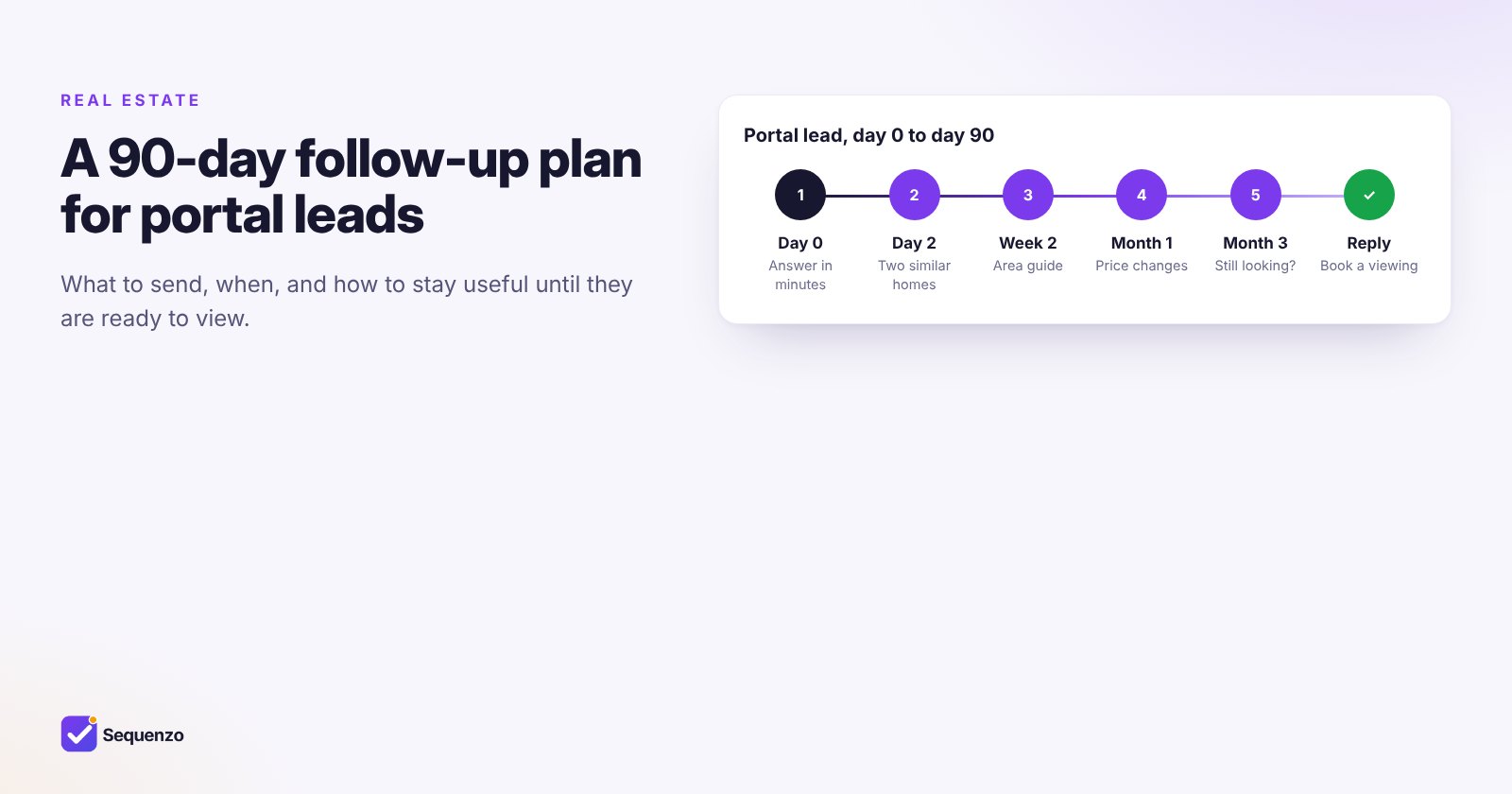
Below is a 90-day email plan for portal and website leads. The rule behind it is that every message should be worth opening. There's a table of the whole plan, ten emails you can adapt, and notes on when to switch from email to a phone call.
Buyers still lean heavily on agents. In the National Association of REALTORS® 2026 Profile of Home Buyers and Sellers, 90% of buyers used a real estate agent or broker, the highest share in four decades. Most of your leads will end up working with an agent. What you're competing on is which one.
This plan is for agents and small agency teams handling buyer leads from property portals, their own website or social media. Seller leads from valuation requests follow a shorter, more intense plan, which is covered in real estate follow-up email templates.
First, answer fast
The first reply matters most. Answer the actual question they asked (is it still available, can they view it, what's included) as quickly as you can, ideally within minutes during working hours. A quick, specific answer shows you're organised and makes it more likely they'll reply to you rather than to the next agent. We look at the research behind response times in why lead response time matters.
Write that first reply yourself. Let automation handle the silence afterwards.
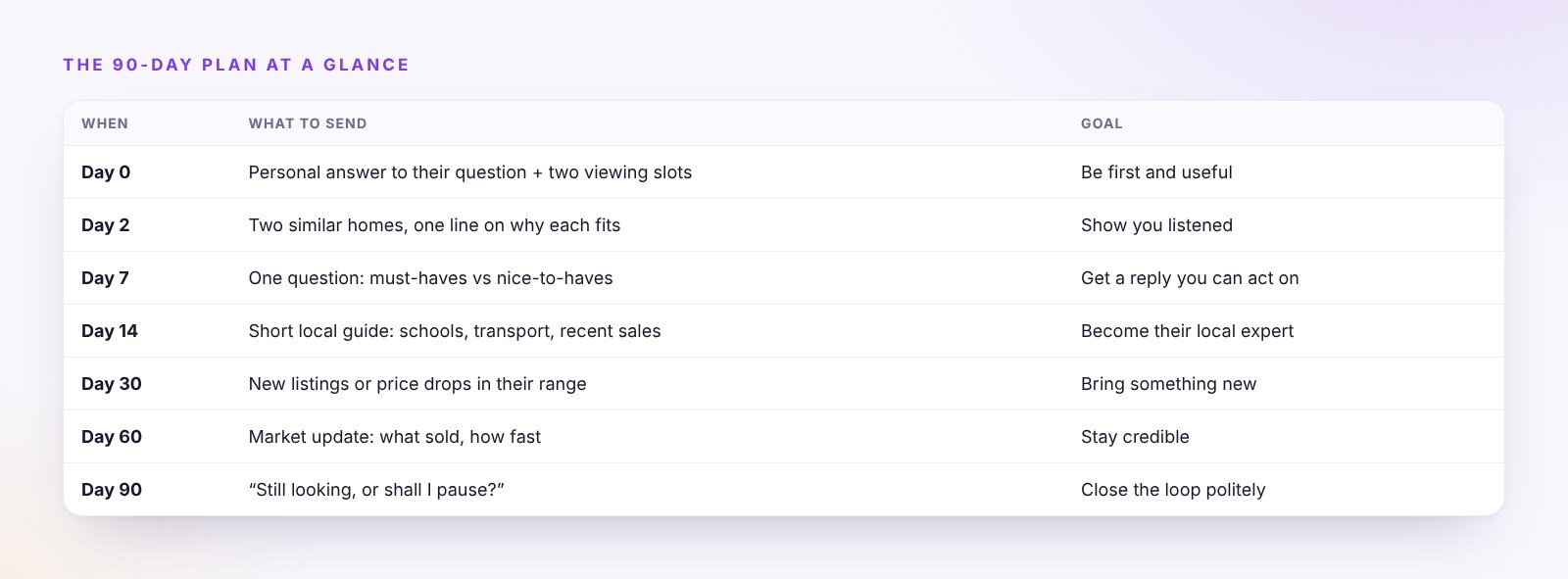
The plan in one table
| Day | Why it's worth opening | |
|---|---|---|
| 0 | The personal answer | Answers their question and offers viewing slots |
| 1 | Viewing reminder or slots | Makes booking a one-word reply |
| 2 | Two similar homes | Gives options if the first home isn't right |
| 7 | One question | Finds out what they actually want |
| 14 | A local guide | Shows you know the area |
| 21 | Mortgage or buying costs | Answers the money question early |
| 30 | Something new | New listings or a price change |
| 45 | A sold price they'd care about | Helps them judge value |
| 60 | A market update | Shows how fast similar homes sell |
| 90 | Still looking? | Asks permission to carry on |
The 90-day plan, step by step
Day 0: the personal answer
"Hi Priya, thanks for asking about the flat on Park Road. Yes, it's still available, and there are viewing slots on Thursday evening and Saturday morning. Would either suit you?"
Day 1: make booking easy
"Priya, just in case it's easier, I've held 6:30pm on Thursday for you. Reply 'yes' and it's booked, or tell me a better time."
Day 2: two similar homes
"Priya, in case Park Road isn't quite right, here are two similar flats in the same price range. The first has the second bedroom you mentioned, and the second is closer to the station. Want to see either?"
Day 7: one question
"Quick question so I only send you relevant homes: what are your must-haves, and what would be nice but optional?"
The answer to this one is worth a lot. It tells you what to send next, and once they've replied you're in an actual conversation.
Day 14: show you know the area
"Here's a short guide to the area: the two primary schools, the commute into town, and what three similar flats sold for this year."
Day 21: the money question
"If it's useful, here's a rough breakdown of buying costs for a flat at this price, and the name of a mortgage adviser our buyers have used. No obligation, of course."
Check local rules on referrals and fees before recommending advisers, and say clearly if you have any arrangement with them.
Day 30: something new
"Two new listings in your range this week, and one price reduction on a flat you looked at. Details below."
Day 45: a sold price
"The two-bed on Elm Avenue you asked about in March sold last week, a little under the asking price. Happy to share what similar flats are going for if you're still looking."
Day 60: a market update
"A quick update: flats like the ones you've looked at are taking around three weeks to go under offer at the moment. If you're thinking of moving before summer, now's a good time to start viewing."
Use figures from your own sales or your local market data, and only state what you can back up.
Day 90: still looking?
"Hi Priya, are you still looking, or shall I pause the updates for now? Either way is completely fine. Just reply with a word."
Adapting the plan to different buyers
First-time buyers
They usually have more questions about the process than about homes. Bring the money email forward to day 7 or 10, and add a plain explanation of what happens between an accepted offer and getting the keys. They are more likely to reply to something that makes the process less confusing.
Investors
They care about rental demand, yields and how quickly similar homes let. Replace the area guide with recent rents for comparable properties, and send new listings sooner, because good ones go quickly.
People relocating
They often can't view in person straight away. Offer video viewings early, send commute times to their new workplace, and ask when they'll next be in the area so you can line up several viewings on one day.
Measuring the plan
Track three numbers each month: how many portal leads got a personal reply within an hour during working hours, how many replied to any email in the plan, and how many booked a viewing. If the first number is low, fix speed before anything else. If the second is low, rewrite the emails that get no answer. The day 7 question and the day 30 "something new" email are usually the strongest, so look at those first.
When to pick up the phone
Email is good at staying in touch without pressure. The phone is better once a buyer shows real interest. Call when they reply with a question about a specific home, when they ask about a second viewing, or when they mention a timeline, such as "we need to move before September". Don't call every lead every day in the first week. A buyer who wanted calls would have rung you.
What makes this plan work
- Same thread, same agent. Each email is a reply in the original conversation, from your own address. The buyer sees one ongoing conversation with one person rather than a drip campaign.
- Every email brings something: a home, a fact, a question, a date.
- It stops when they reply. Few things undo trust faster than an automated "new listings!" email arriving after the buyer has just told you they bought elsewhere.
- It ends politely. Day 90 asks permission to continue.
Mistakes that lose portal leads
- A slow first answer. Buyers often enquire with several agents at once.
- Generic newsletters instead of follow-ups. A monthly blast to every lead isn't a conversation.
- Calling and emailing every day in week one. Being persistent is fine. Pestering isn't.
- Adding leads to a marketing list without permission. One-to-one follow-ups about the property they asked about are expected, but a general newsletter usually needs their consent. See follow-up emails and the law.
Leads that come back later
Some buyers go quiet for six months and then send a new enquiry on a different home. When that happens, treat it as a new conversation but use what you already know. Reply quickly, mention what they told you before ("you were looking for three bedrooms near the school, is that still right?"), and start the plan again from day 0. They'll notice that you remembered, and it's a big part of why they came back to you rather than to the agent on the new listing.
If a buyer told you on day 90 to pause the updates, respect that. Don't restart the plan until they get in touch again.
Putting it on autopilot
You can run this plan by hand with a spreadsheet and calendar reminders, but it falls apart as soon as you get busy, and busy weeks are when the leads arrive. Sequenzo lets you save the plan as a follow-up flow, pick it in Gmail or Outlook when you send the first reply, and let each step go out from your own mailbox. A reply stops the flow straight away, and reply alerts tell you who to call.
For more ready-to-use wording, see real estate follow-up email templates, and for how Sequenzo fits an agent's day, see email follow-ups for real estate agents.
Frequently asked questions
Q01How long should a real estate agent follow up with a lead?
Many buyers and sellers take months to be ready, so a plan of around 90 days works well for portal and website leads, with messages getting less frequent over time and a polite check-in at the end.
Q02How often should I email a real estate lead?
More often at the start (day 0, 2 and 7), then every couple of weeks, then monthly. Each email should bring something new: a home, local information, a market update or a simple question.
Q03Should real estate follow-ups be automated?
The first reply should be personal and fast. Later follow-ups can be automated if they go out from your own mailbox, read like you wrote them, and stop as soon as the lead replies.
Q04Can I add portal leads to my newsletter?
One-to-one follow-ups about the property they asked about are expected. A general marketing newsletter is different and usually needs their permission, depending on where you and the lead are located.