On this page 9 sections
You sent a good email. A day passed, then three, then a week, and nothing came back. It's tempting to read that as a no, but usually it isn't. Your email slid below forty newer ones, arrived while the person was in a meeting, or needed an answer from someone else first. A short follow-up at the right time sorts this out more often than you'd expect.
This guide covers how long to wait, how many times to follow up, what to say in each email, and what to leave out. There are ten templates you can copy, a timing table, and a section on doing it without a spreadsheet of reminders.
Who this is for: anyone following up on an email they sent to a real person who has a reason to reply, such as a quote, a proposal, a viewing, a job offer or an introduction. If you are emailing a list of strangers, this isn't the right guide; cold outreach has its own rules and legal requirements.
How long to wait before following up
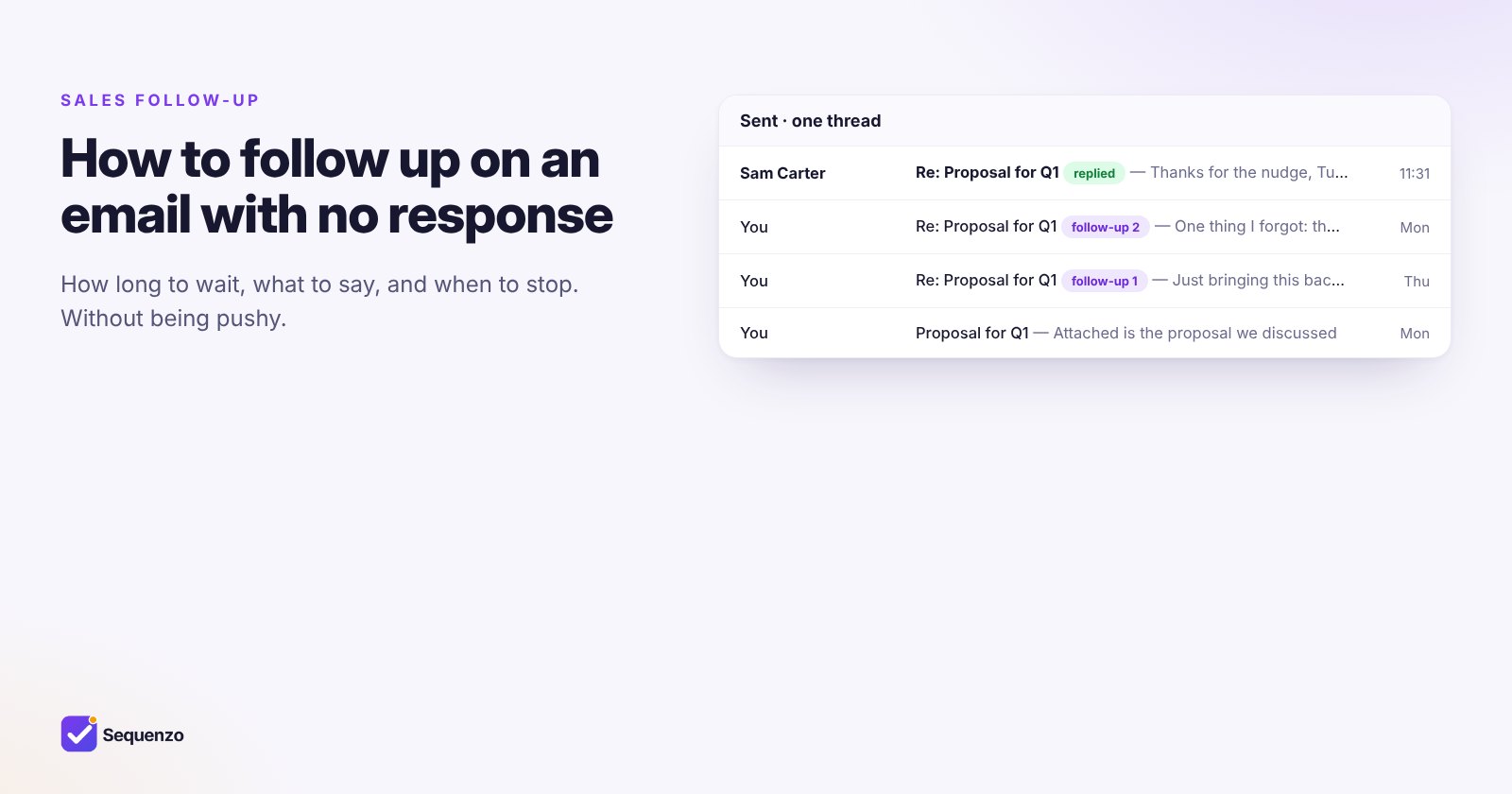
For most business email, two to three working days is a good first gap. Any sooner can feel pushy, because you haven't given the person a fair chance to reply. Much later and the conversation has gone cold, so you are starting again rather than continuing.
After the first follow-up, leave longer gaps each time. The first reminder is the most likely to get an answer, and each one after that is a little less welcome, so space them out. Time-sensitive emails are the exception. If you sent a quote that expires on Friday or a viewing slot for Saturday, follow up sooner and say why.
A timing table you can use
| Step | When | What it does |
|---|---|---|
| Original email | Day 0 | The request, with everything they need to answer |
| Follow-up 1 | Day 2 or 3 | Checks it arrived, adds one useful detail |
| Follow-up 2 | Day 6 or 7 | Makes the ask smaller or offers an option |
| Follow-up 3 | Day 12 to 14 | Asks an either/or question about timing |
| Last email | Day 20 to 30 | Closes the loop politely and leaves the door open |
Count working days if the person works office hours, and send during their working day in their time zone. A follow-up that arrives at 9:40 on a Tuesday gets a different reception from one that arrives at 23:15 on a Saturday.
How many times to follow up
Three follow-ups after your first email is right for most situations, with a fourth that politely closes the loop. After that, stop. If you keep going, a quiet "maybe later" turns into an unsubscribe or a spam report, and you lose the chance to pick it up later.
Two situations call for fewer. If the person replied once and then went quiet, one or two follow-ups is usually enough, because you know the email reached them. If they asked you to stop, stop, and remove any scheduled follow-ups straight away.
What makes a follow-up work
- Reply in the same thread. The original email stays underneath, so the person doesn't have to search for what you're talking about. There is more on this in follow-up email subject lines.
- Keep it to two to four sentences. People read follow-ups on their phones between other things.
- Bring something new each time. "Just checking in" gives nobody a reason to answer. A date, a detail, an option or a simpler question does.
- End with one question that can be answered in a line.
- Stop as soon as they reply, even if the reply is "not now".
Ten follow-up emails for when someone goes quiet
Each template is short on purpose. Replace the parts in brackets, and change the wording so it sounds like you.
1. The first nudge (day 2 or 3)
"Hi [Sam], I wanted to make sure this didn't get buried. Is [the proposal] what you were after, or should I change anything before you share it with [your manager]?"
It assumes the email got lost, which is usually true, and asks a question that's easy to answer.
2. Add something new
"Hi [Sam], one more thought on this: I can send a short example of how it worked for a team your size, so you can judge it in two minutes. Want me to send it?"
3. Make the ask smaller
"[Sam], would a 15-minute call on Tuesday or Wednesday be easier than going back and forth by email?"
When someone hasn't answered a big question, a smaller one often gets the conversation going again.
4. Offer two options
"Hi [Sam], to make this easier I've put together two versions: the full [project] and a smaller first phase. Which is closer to what you need?"
5. Check you have the right person
"Hi [Sam], am I asking the right person about [this]? If someone else looks after it, I'd be grateful for a name and I'll stop filling your inbox."
This works well in larger companies, where the person you met may not be the one who decides.
6. Mention a real deadline
"Hi [Sam], a quick note that [the price / the slot] is held until [Friday]. If you'd like to keep it, a one-line reply is enough."
Only use a deadline that's true. People notice invented urgency, and you lose their trust for the next conversation.
7. The either/or question on timing
"Hi [Sam], is this something you're looking at now, or should I check back next quarter?"
8. The easy out
"Is the timing just off? No problem at all. Tell me when would be better and I'll follow up then."
9. Share something useful
"Hi [Sam], I came across [an article / an example] about [their problem] and thought of our conversation: [link]. No need to reply if now isn't the time."
Use this between other follow-ups. It keeps you in touch without asking for anything.
10. Close the loop
"Hi [Sam], I'll assume now isn't the right time and close this on my side. If anything changes, just reply to this email and it'll come straight to me."
The last email often gets a reply when the others didn't, because it asks for so little. There is a whole guide on it: how to write the breakup email.
Examples by situation
The templates above are general. Here is how the first follow-up might look in a few specific cases.
- After a quote: "Did the quote come through OK? I'm happy to walk you through any line in ten minutes." More in following up on a quote or proposal.
- After a meeting: "Thanks again for Tuesday. I've attached the summary we talked about. Did I miss anything?" More in the follow-up email after a meeting.
- After a viewing: "Now that you've had a day to think about [the house], how does it sit with you?" More in real estate follow-up templates.
- After a test drive: "Did the numbers make sense? I can price a different term or deposit if that helps." More in car sales follow-up emails.
What not to write
- "As per my last email..." It reads as a telling-off.
- "I haven't heard back from you." It makes the other person feel guilty, which doesn't make them want to reply.
- "Did you get my email???" Extra punctuation looks impatient and can trip spam filters.
- "Just bumping this to the top of your inbox." It's fine once. By the third time it says nothing.
- A long recap of everything you've sent before. If they need it, it's in the thread.
Each of these puts the other person on the defensive. Keep it warm and brief instead.
When a reply isn't really a reply
An out-of-office message isn't an answer. Wait until the person is back, then follow up a day or two later. A bounce means the address is wrong, so find the right one before you send anything else. A one-word "thanks" is a reply, even if it doesn't answer your question. Stop the automated follow-ups and answer it yourself, usually with a direct question.
Follow-ups and the law
A follow-up to someone who asked for a quote or met you is a normal business email. If you are writing to people who never contacted you, rules such as CAN-SPAM in the US, PECR and GDPR in the UK and EU, and CASL in Canada apply in different ways. The short version is to be honest, include a way to opt out, and stop when asked. See follow-up emails and the law.
Let the follow-ups send themselves
The hard part of following up isn't writing the email. It's remembering to send it, for every conversation, at the right time. Sequenzo sends your follow-ups from your own Gmail or Outlook inbox, in the original thread, on the schedule you choose, and stops when they reply. It checks the thread again a few seconds before each send, so a reply that arrives at the last minute still cancels the rest, and an out-of-office reply pauses the flow until the person is back. A built-in coach also scores each follow-up before it goes out and flags things like a bare "just checking in". If you want to try it on your own mailbox, setting up your first flow takes about ten minutes.
Frequently asked questions
Q01How long should you wait to follow up on an unanswered email?
Two to three working days for the first follow-up, then longer gaps after that, for example day 3, day 7 and day 14.
Q02Is it rude to follow up on an email?
No. A short, polite follow-up that adds something useful is normal and usually welcome. What feels rude is guilt ("I haven't heard back"), long emails, or reminders after someone has already replied.
Q03How many follow-up emails is too many?
For most conversations, more than three or four follow-ups after the first email is too many. Make the last one a friendly message that closes the loop.