On this page 11 sections
Following up with someone who asked about your product is a normal part of doing business. Commercial email is still regulated, though, and the rules differ between countries. This is a plain-English overview of the main laws for small sales teams in the US, the UK and EU, and Canada. It is not legal advice; if you send at volume or in a regulated industry, talk to a lawyer.
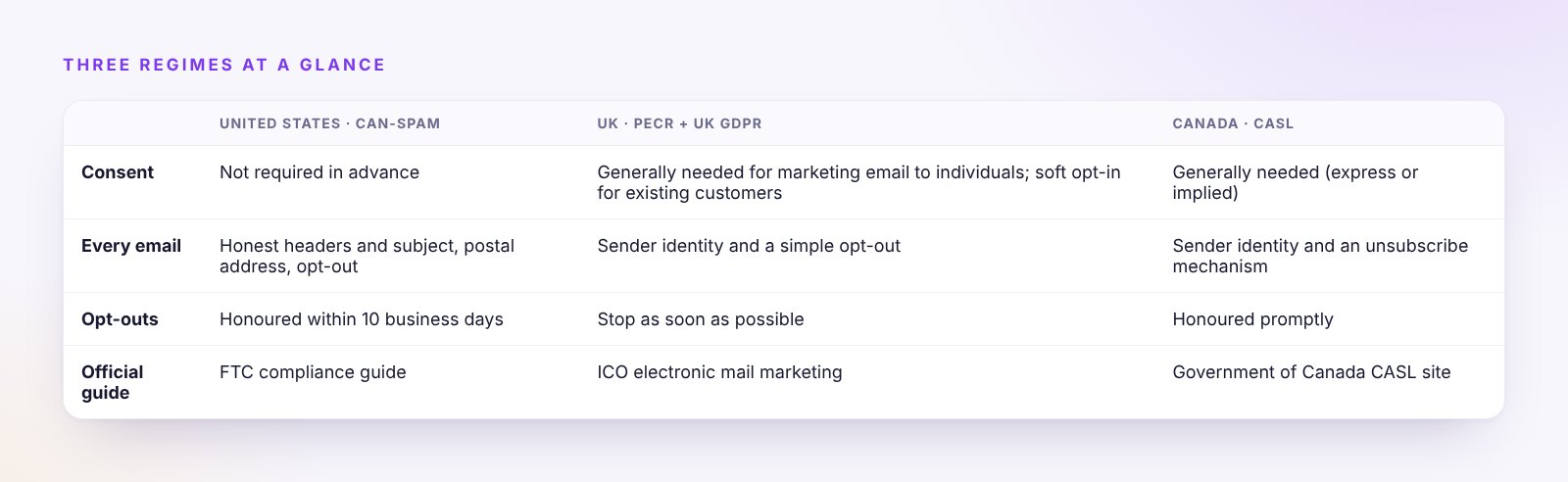
This overview is for salespeople, agents, brokers, recruiters and small businesses following up on conversations by email. It explains the main rules in plain English so you can ask better questions. It isn't legal advice, and the rules change, so check the official guidance linked below or ask a lawyer for anything you send at volume.
The rules at a glance
| US (CAN-SPAM) | UK (PECR + UK GDPR) | Canada (CASL) | |
|---|---|---|---|
| Consent needed before emailing? | No, for commercial email | Yes for individuals, with exceptions; not for most company addresses | Yes, express or implied |
| Identify the sender | Yes | Yes | Yes |
| Postal address | Yes, a valid physical address | Contact details required | Mailing address required |
| Working opt-out | Yes | Yes, in every message | Yes |
| Time to honour opt-outs | 10 business days | As soon as possible | 10 business days |
United States: CAN-SPAM
The CAN-SPAM Act covers commercial email, and the FTC's CAN-SPAM Act: A Compliance Guide for Business sets out its main requirements:
- Don't use false or misleading header information.
- Don't use deceptive subject lines.
- Identify the message as an ad (where it is one).
- Tell recipients where you're located: a valid physical postal address.
- Tell recipients how to opt out of receiving future marketing email from you.
- Remember that subscribers and members can opt out of marketing emails, too.
- Honor opt-out requests promptly (the FTC guide says within 10 business days).
- Monitor what others are doing on your behalf.
The FTC notes that each separate email in violation can be subject to penalties of up to $53,088. CAN-SPAM doesn't require prior consent, but it does require honesty and a working opt-out.
Many one-to-one follow-ups about a deal someone is already discussing with you are "transactional or relationship" messages rather than pure ads. The FTC guide explains the distinction. Honesty in headers and subject lines applies either way. That's one reason never to fake "Re:" on a first email (see follow-up subject lines).
United Kingdom: PECR and UK GDPR
In the UK, electronic marketing is governed by the Privacy and Electronic Communications Regulations (PECR), alongside UK GDPR for personal data. The ICO's guidance on electronic mail marketing explains the general rule (consent for marketing email to individuals) and the "soft opt-in" for existing customers: you may email people who bought, or negotiated to buy, a similar product or service from you, as long as you gave them a chance to opt out when you collected their details and in every message.
The ICO notes this guidance is under review following the Data (Use and Access) Act 2025, so check the current version. In the EU, similar rules come from the ePrivacy Directive (as implemented in each country) together with the GDPR.
Emailing companies in the UK
PECR treats "corporate subscribers" differently from individuals. Marketing email to an address at a limited company or similar organisation doesn't need consent under PECR, though you must still say who you are and give a way to opt out, and UK GDPR still applies to the personal data involved. Sole traders and some partnerships are treated as individuals, so the consent rules apply to them. A follow-up to someone who asked you for a quote is a different matter again, because it is a response to their request rather than unsolicited marketing.
Canada: CASL
Canada's Anti-Spam Legislation is stricter: commercial electronic messages generally need consent (express or, in defined situations, implied, for example an existing business relationship or an enquiry within a limited time), along with sender identification and an unsubscribe mechanism. See the Government of Canada's Canada's anti-spam legislation site.
How long implied consent lasts under CASL
CASL sets time limits on implied consent. An enquiry or application generally gives implied consent for six months, and an existing business relationship based on a purchase generally lasts two years. After that you need express consent to keep sending commercial messages. For follow-ups, the practical point is that reviving a two-year-old enquiry by email may need a different footing than following up last week's quote.
Other countries in brief
Australia's Spam Act requires consent (express or inferred), clear identification of the sender and a working unsubscribe, which must be honoured within five business days. In the EU, the ePrivacy rules are implemented country by country, so the details differ, and the GDPR applies to the personal data in every case. If you follow up with people in several countries, the safest default is to follow the strictest set of rules that applies.
Which follow-ups are marketing?
The laws mostly regulate commercial or marketing email. A lot of follow-up email sits at the edge of that definition:
- Following up on a quote someone requested, or a meeting they booked, is closely tied to their own request.
- Reminding an existing client about a renewal or an unpaid invoice is mainly about an existing relationship.
- Sending a general offer to a past enquirer months later is much closer to marketing.
- Emailing people who never contacted you is marketing, and it's where most rules are strictest.
The further a follow-up moves from what the person asked for, the more the marketing rules matter. When in doubt, treat it as marketing: identify yourself, include an opt-out and honour it.
Rules for particular industries
- Insurance and mortgages: financial regulators often have their own rules on promotions and record keeping, on top of the email laws. Check what your regulator says about clear, fair and not misleading communications. See insurance follow-up templates.
- Recruitment: candidate CVs and details are personal data, and you need a lawful basis to keep and share them. Only send a CV to a client the candidate has agreed to. See recruiter follow-up templates.
- Real estate and car sales: portal and marketplace leads often come with the platform's own terms on how you may contact the buyer. Read them before adding leads to any automated sequence.
Wording for an opt-out line
For one-to-one follow-ups, a plain sentence works better than a block of legal text, and people use it instead of pressing "Report spam":
- "If you'd rather I didn't follow up, just reply and say so."
- "Not interested? Reply 'stop' and I won't email you about this again."
For anything closer to marketing, include a one-click unsubscribe link as well, and make sure it works without the person having to log in.
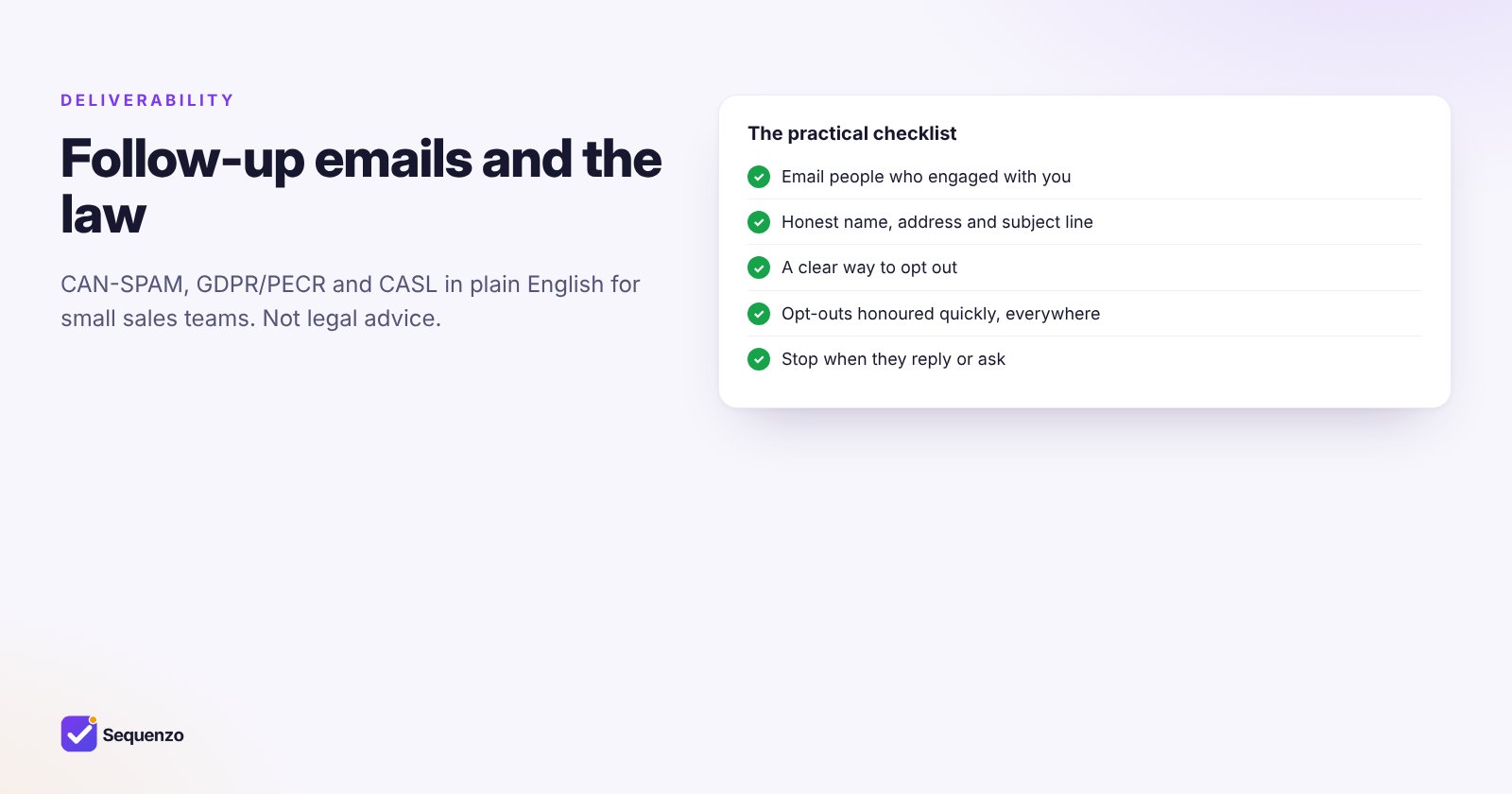
A practical checklist for sales follow-ups
- Follow up with people who engaged with you: enquiries, quotes, meetings, existing customers. Don't email bought or scraped lists.
- Be honest: real name, real address, subject lines that describe the email.
- Include a way to opt out and honour it everywhere, quickly.
- Stop when asked, and stop when someone replies so they're not chased by automation.
- Keep a record of where each contact came from.
- Put your postal address in your email footer or signature.
Mailbox providers have their own rules on top of the law, such as authentication and spam-rate limits. See why follow-up emails go to spam.
Keeping records
If someone ever asks why you emailed them, you'll want to show where their address came from and what you sent. Keep the original enquiry, note the date and source of each contact, and log follow-ups in your CRM. Logging follow-ups with a BCC address covers one simple way to do that. Delete contacts you no longer have a reason to keep.
How Sequenzo helps
Sequenzo is built for following up on conversations you started. It isn't for cold or bulk email, and its acceptable use policy prohibits bought or scraped lists. It offers a one-click unsubscribe that needs no login, applies opt-outs across your whole workspace (stopping every pending follow-up), refuses to enrol anyone on your do-not-contact list, adds your postal address to the footer, and supports data export and erasure requests. See our Acceptable Use Policy and Privacy Policy.
Frequently asked questions
Q01Do sales follow-up emails need consent?
It depends on where the recipient is and your relationship with them. The US CAN-SPAM Act does not require prior consent but requires honesty and an opt-out. The UK and EU generally require consent for marketing email to individuals, with exceptions such as the UK soft opt-in for existing customers. Canada's CASL generally requires express or implied consent.
Q02What must every commercial email include under CAN-SPAM?
Accurate header information, a non-deceptive subject line, a valid physical postal address, a clear way to opt out, and identification as an ad where applicable. Opt-outs must be honoured within 10 business days.
Q03What is the soft opt-in?
A UK PECR rule that allows marketing email to existing customers who bought or negotiated to buy a similar product or service, provided they were given a chance to opt out when their details were collected and in every message.
Q04Is this legal advice?
No. It is a plain-English overview. If you send at volume or work in a regulated industry, take advice from a qualified lawyer.