On this page 9 sections
People who enquire about a training course are rarely ready to book there and then. They want the certificate, but they also need to check dates with their manager, find out whether their employer will pay, and decide whether they can face studying in the evenings for six weeks. That takes a while. If nobody follows up in the meantime, the enquiry usually just fades away.
This article is for training companies, bootcamps and certification providers who get a steady flow of course enquiries and want more of them to turn into enrolments. Most of it also applies if you sell workshops or corporate training.
Why course enquiries go quiet
When people do eventually reply, their reasons tend to fall into a handful of groups:
- They need sign-off from a manager, or the training budget won't be confirmed until next quarter.
- The next batch starts on dates that clash with something, and they are waiting to see the one after.
- They aren't sure they have the background for the course and are a bit embarrassed to ask.
- They asked two or three providers at once and are comparing prices, formats and pass rates.
- They meant to reply, and then it was Friday.
Each of those has an obvious follow-up, and the templates below are built around them.
Time follow-ups from the start date
With most sales follow-up you count days from your last email. Courses are different, because there is a fixed date that matters more: when the next batch starts. Someone who enquires eight weeks out needs a slower sequence than someone who enquires nine days before the class begins.
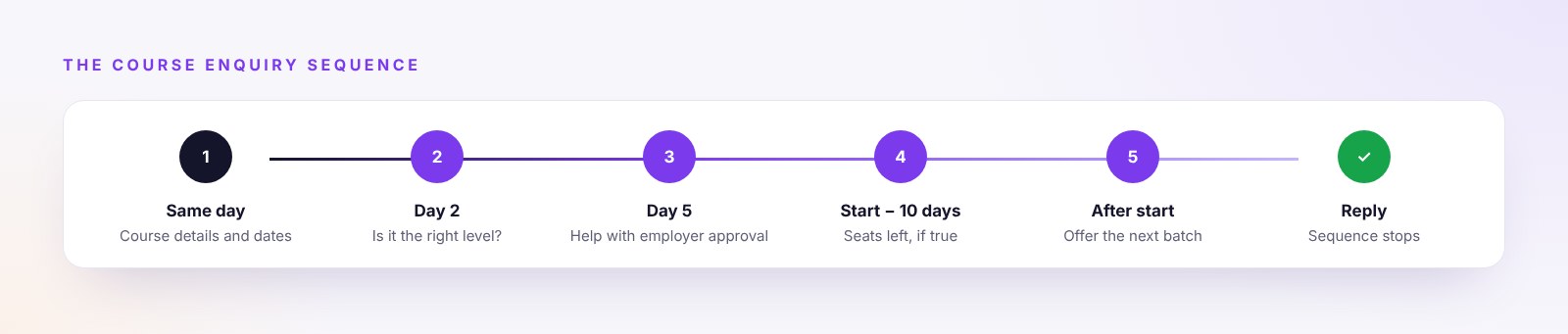
A sensible default looks like this:
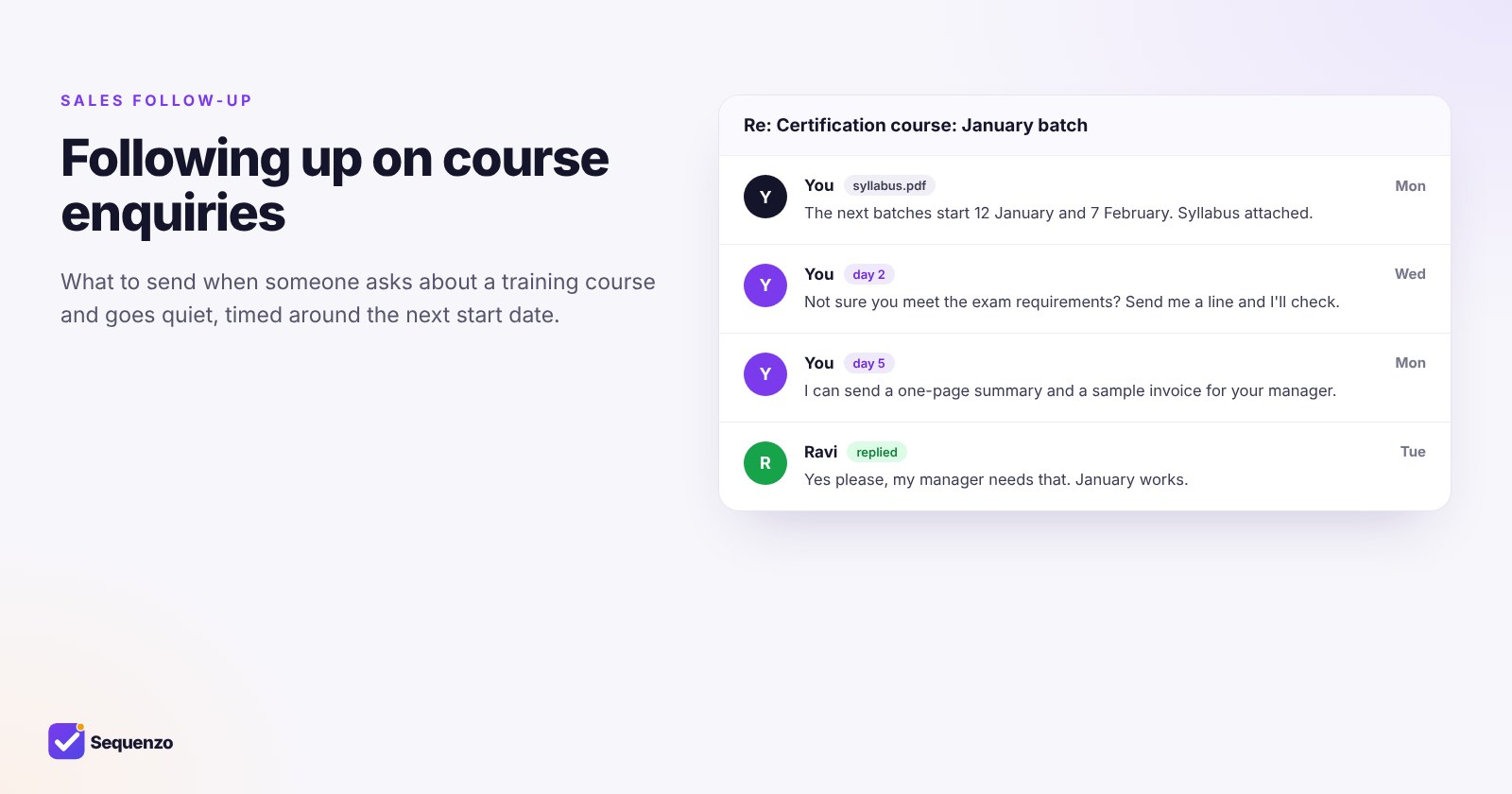
- Same day: the course details they asked for, the next two start dates and the price.
- Day 2: an offer to check whether the course is the right level for them.
- Day 5: help with getting approval or funding from their employer.
- About ten days before the batch starts: an honest note on how many seats are left, if seats really are limited.
- After the batch starts: a short message offering the next one. Then stop.
Six course enquiry follow-up templates
1. Course details (same day)
"Hi Ravi, thanks for asking about the project management certification course. The next two batches start on 12 January (weekday evenings) and 7 February (weekends). The fee includes the exam voucher and the practice tests. I've attached the syllabus. If you tell me a bit about your current role, I can suggest which batch would suit you better."
2. Is it the right level? (day 2)
"Hi Ravi, a question people often don't like to ask: do you need any background before starting? For this course, a couple of years working on projects in any role is enough. If you're not sure you qualify for the exam, send me a line about your experience and I'll check it for you."
It lets someone ask the question they were worried about without having to raise it themselves.
3. Employer approval (day 5)
"If your company is paying, it can help to send your manager something short. I've put together a one-page summary covering what the course covers, the dates and the cost, plus a sample invoice in your company's name. Want me to send it over?"
4. Comparing providers (day 8)
"If you're looking at a few options, it's worth comparing what's included in the price as well as the fee itself: exam voucher, retake policy, practice tests and how long you can access the material afterwards. Happy to answer anything about ours."
5. Seats and dates (about ten days before the start)
"The 12 January batch has four seats left. If you'd like one, a reply is enough to hold it for 48 hours while you sort out payment. If January is too soon, the February batch is still wide open."
Only send this if it's true. People who take certification courses often talk to each other, and a made-up "last few seats" every month gets noticed.
6. Close the loop (after the batch starts)
"The January batch started this week, so I'll stop emailing about it. If the timing works better later in the year, reply to this email and I'll send you the new dates."
An example from certification training
Certification providers have a particular version of this problem, because their learners are usually working adults on a deadline. Take SterlingNext, which runs instructor-led certification courses in areas such as project management, quality management and IT service management. Someone enquiring about a PMP course is probably fitting the course around a full-time job, may need their employer to pay, and may already have an exam date in mind. One follow-up with the exam eligibility rules, a sample invoice for their employer and the batch dates answers most of what is holding that person back.
The same thinking works for any training business. Before you write the sequence, write down the three or four questions your best learners asked before they enrolled. Then give each question its own follow-up.
Corporate and group enquiries
When an HR or L&D manager asks about training for a team, the sale moves more slowly and involves more people. Follow up with things they can forward: a short proposal, a draft schedule and a quote broken down per learner. Our guide to following up on a quote or proposal has wording for this, and the follow-up email after a meeting covers the recap after a scoping call.
A follow-up for a corporate enquiry
"Hi Meera, thanks for asking about training for your team of twelve. I've attached a draft schedule for two cohorts and a quote broken down per learner. If it would help, I can join a short call with your L&D lead to adjust the dates. Would next week work?"
After someone attends a free webinar or taster session
"Hi Ravi, thanks for joining the taster session on Tuesday. The recording is below. You asked about the exam format: it's [number] questions over [time], and the course includes [practice exams]. Want me to hold a seat on the January batch?"
Check exam details against the certifying body's current rules before you send anything like this; formats change.
When the answer is "too expensive"
Price comes up in most course enquiries sooner or later. Before offering a discount, check what the person is comparing you with. A cheaper course may not include the exam fee, retakes or practice tests. Set out what yours includes in one short list, mention any instalment option you really offer, and ask whether their employer has a training budget they could use. If the price is still the problem, say so plainly and suggest the next batch if it costs less.
Measuring what works
Track three numbers each month: how many enquiries got a reply the same day, how many replied to any follow-up, and how many enrolled within 60 days. If replies are low, rewrite the follow-ups that nobody answers. If replies are high but enrolments are low, the obstacle is usually price, dates or employer approval, and the next step is a better answer to that question, not more emails.
Mistakes that lose enrolments
- Sending a brochure and nothing else. A PDF answers the question they asked and leaves the others hanging.
- Adding enquiries to a newsletter. Someone who asked about one course wants an answer about that course, in a reply to their email.
- Discounts that expire at midnight. They make a professional course look less credible.
- Carrying on after they reply. If someone answers "my manager is checking", a reminder about seats two days later looks careless.
Doing it without a spreadsheet
If you handle more than a few enquiries a week, it's hard to remember who needs which email. With Sequenzo you write the sequence once and pick it when you reply to the enquiry from Gmail or Outlook. The follow-ups go out from your own mailbox, in the same thread, and the sequence stops as soon as the person replies. If you want enquiries logged in a CRM as well, see how to log follow-up emails in your CRM with a BCC address. Teams with several course advisers can share one flow, as described on follow-ups for small sales teams.
Frequently asked questions
Q01How soon should I follow up on a course enquiry?
Send the course details the same day, then follow up about two days later. After that, base the timing on when the next batch starts rather than on a fixed number of days.
Q02How many follow-ups should a training provider send?
Four or five is usually enough, as long as each one answers a real question: the right level, employer approval, what is included, and the dates. Stop once the batch has started and offer the next one.
Q03Should I offer a discount to people who haven't booked?
Not as a first move. Help with employer approval and a clear list of what the fee includes usually works better, and it doesn't teach learners to wait for a deal.
Q04Can I add course enquiries to my newsletter?
Only if they agreed to it. A reply about the course they asked about is a normal one-to-one email. A marketing newsletter needs consent in many countries, so check the rules where your learners live.