On this page 12 sections
- When to send it
- The timing after the meeting
- The four-part structure
- Nine templates
- What to leave out
- Recaps for meetings with several people
- A weak recap and a better one
- A recap you can copy
- Measuring whether recaps work
- When the meeting didn't go well
- If the recap gets no reply
- Sending the follow-ups automatically
A good meeting can still go nowhere. Everyone leaves with a slightly different memory of what was agreed, the next step has no date, and two weeks later you're writing "just checking in". A short recap email sent the same day prevents most of this, and it takes about five minutes to write.
This guide covers the recap itself, what to send if the other person goes quiet afterwards, and nine templates for sales calls, demos, viewings, site visits and no-shows.
This guide is for anyone who has meetings that should lead somewhere: salespeople after a discovery call or demo, agents after a viewing or valuation, consultants after a pitch, recruiters after an interview. The same structure works for internal meetings, but the examples are written for clients.
When to send it
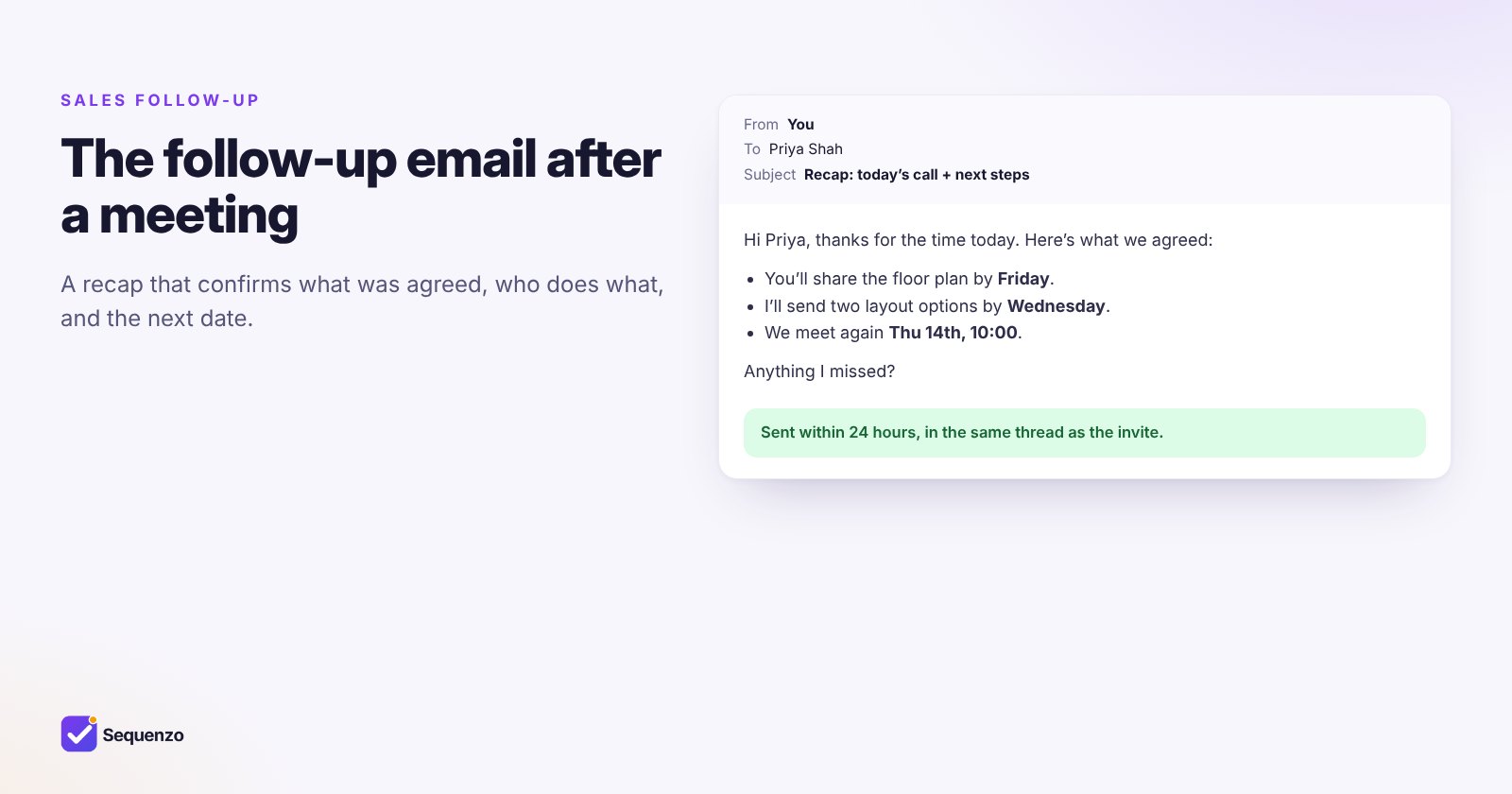
Within 24 hours, and ideally within a few hours while the details are fresh for both of you. If you sent the meeting invite by email, reply in that thread, so the recap sits under the invitation and the agenda.
The timing after the meeting
| When | Why | |
|---|---|---|
| Same day | Recap: decisions, owners, next date | Turns the conversation into a plan |
| Day before the next step | Confirmation | Stops no-shows and last-minute surprises |
| 3 or 4 working days, if no reply | Short follow-up that adds something | Brings the thread back to the top |
| 1 day after an agreed step slips | Friendly check, smaller ask | Gets things moving without blame |
| 2 to 3 weeks, if still quiet | Close the loop | Lets them say "not now" |
The four-part structure
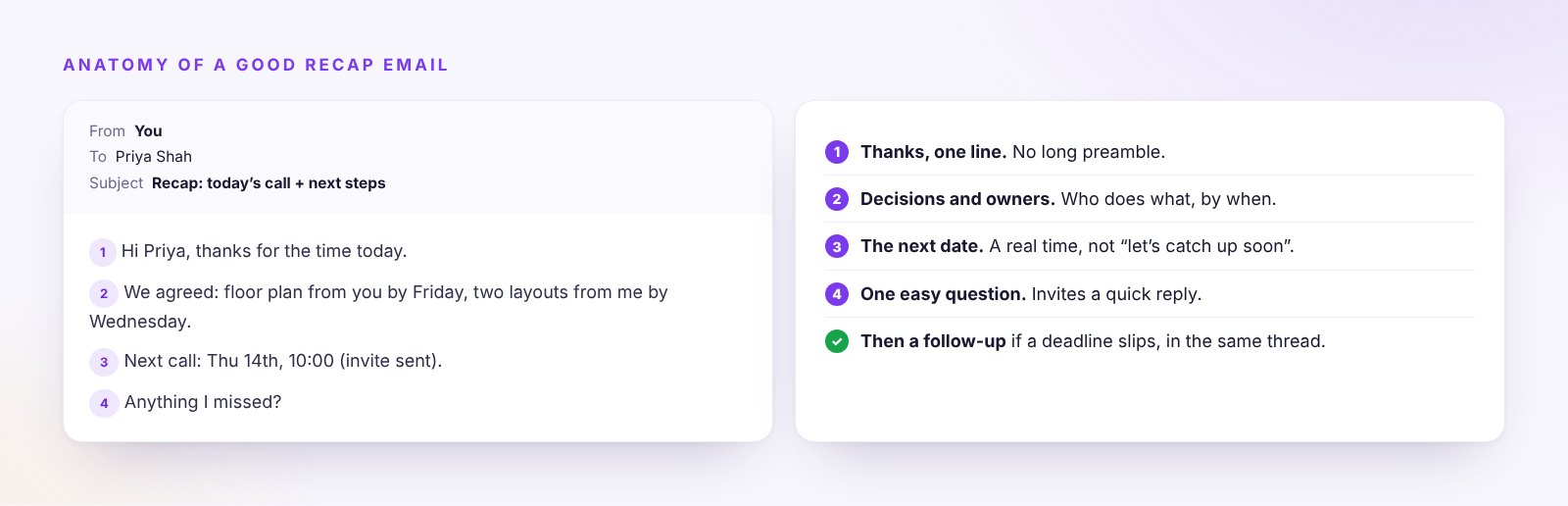
- Thanks, in one line. Skip the long preamble.
- What was agreed, with owners and dates: "You'll send the floor plan by Friday. I'll send two layouts by Wednesday."
- The next date. A real time, not "let's catch up soon". If you can, send the calendar invite at the same time.
- One easy question. "Anything I missed?" invites a quick reply and confirms they read it.
Nine templates
1. After a sales call or discovery meeting
"Hi Priya, thanks for the time today. To recap: you're looking to cut response times on inbound leads before the spring campaign, and the main constraint is that your team works from Outlook. I'll send a short proposal by Wednesday; you'll check the budget range with Mark. Next call: Thursday 14th at 10:00 (invite sent). Anything I missed?"
2. After a demo
"Thanks for joining the demo, Sam. The two things you wanted to see again were the reply detection and the team view. I've put the short recording links below. Would it help if I set up a trial account for you and Jess so you can test it on real emails this week?"
3. After a viewing or site visit
"Hi Jordan, thanks for coming to see 14 Maple Street. You mentioned the garden and the school run were the deciding factors, and that you'd like to check the survey. I've attached the floor plan. Shall I pencil in a second viewing for Saturday morning?"
For more property examples, see real estate follow-up email templates.
4. After a pitch or proposal meeting
"Hi Daniel, thanks for having us in today. You liked the phased approach and asked us to cost phase one separately. I'll send that by Friday, along with the two case studies we mentioned. Who else should see it before your board meeting on the 22nd?"
5. After an interview (recruiter to candidate)
"Hi Aisha, thanks for meeting the finance director today. She'll give me feedback by Thursday, and I'll call you as soon as I have it. In the meantime, is there anything you'd like me to find out about the role?"
6. When they didn't show up
"Hi Alex, sorry we missed each other today. No problem at all. Here are two other times that work for me: Tuesday 3pm or Wednesday 11am. Or reply with a time that suits you."
Keep it warm. People miss meetings for ordinary reasons, and making them feel bad guarantees they won't rebook.
7. Confirming the next meeting
"Hi Priya, just confirming we're still on for Thursday at 10:00. I'll bring the two layouts we talked about. If anything has changed, reply with a better time."
8. When the agreed next step slips
"Hi Priya, I was expecting the floor plan on Friday, so I wanted to check in case it's stuck somewhere. If it's easier, a photo of the sketch is enough for me to start."
It names the step you agreed on, assumes they have a good reason for the delay, and makes replying less work.
9. Closing the loop after a quiet few weeks
"Hi Priya, I haven't heard back since our call, so I'll assume the timing has changed and close this on my side for now. If spring is still on the cards, just reply here and we'll pick up from the proposal."
What to leave out
- The full minutes. Send notes separately if they need them. The recap is about decisions and dates.
- A new pitch. You pitched in the meeting. The recap is about what happens next.
- Attachments nobody asked for. Link to them, or offer them.
- Vague next steps. "Let's touch base" isn't a plan. A day and a time is.
Recaps for meetings with several people
When five people were in the room, send the recap to all of them and name an owner for every action. It feels formal, but it's the only way to stop each person assuming someone else is doing it. Keep the list short, put the next meeting date at the top, and ask the most senior person on their side a direct question so the thread doesn't stall waiting for whoever replies first.
A weak recap and a better one
Before: "Great to meet you today! Lots of exciting stuff to think about. Let's touch base soon to discuss next steps. Let me know if you have any questions!"
After: "Thanks for today, Priya. Agreed: I'll send the proposal by Wednesday, and you'll confirm the budget with Mark. Next call: Thursday 14th at 10:00 (invite sent). Anything I missed?"
The first version is friendly and says nothing. Nobody owns anything and there's no date, so both people will have forgotten it by Friday. The second takes the same time to read and leaves no doubt about what happens next.
A recap you can copy
If you write a lot of these, keep a skeleton in your templates and fill the gaps straight after the meeting:
"Hi [name], thanks for [today / the call]. To recap: [their goal or problem in one sentence]. Agreed next steps: [you] will [action] by [date]; [they] will [action] by [date]. Next [meeting / call]: [day, date, time] (invite sent). Anything I missed?"
It takes two minutes, and filling it in shows you where the meeting was vague. If you can't write the "agreed next steps" line, nothing was agreed, and the best move is to ask: "What would be a useful next step from here?"
Measuring whether recaps work
If you want to know whether this is worth the effort, count two things for a month: how many meetings had a next step booked within a week, and how many recaps got a reply. Most people find both go up as soon as recaps become a habit, and the second number tells you which wording works best.
When the meeting didn't go well
Send a recap anyway. If the client raised an objection you couldn't answer on the spot, the recap is your chance to answer it properly: "You asked whether this works with your Outlook setup. I checked, and it does; here's the short guide." If it became clear you're not the right fit, say so and suggest what might be. People remember an honest recap, and some of them come back when their situation changes.
What you shouldn't do is pretend the meeting went better than it did. A recap that lists "agreed next steps" nobody agreed to will be ignored, and it makes the next email harder to write.
If the recap gets no reply
Treat it like any other quiet thread: a short follow-up after three or four working days, then one that adds something new, then a polite close. Our follow-up cadence playbook has the timing, and how to follow up on an email with no response has the wording.
Sending the follow-ups automatically
If you'd rather not track this by hand, Sequenzo can send those follow-ups for you from your own Gmail or Outlook, in the same thread as your recap, and stop as soon as the other person replies. It also stops when a meeting is marked booked. See how to set up your first follow-up flow, or the time zone meeting planner if your next call is across time zones.
Frequently asked questions
Q01How soon should I send a follow-up email after a meeting?
Within 24 hours, and ideally the same day. The details are fresh for both of you, and a quick recap shows you took the meeting seriously.
Q02What should a meeting follow-up email include?
A one-line thank you, what was agreed with owners and dates, the next meeting or step with a real date, and one easy question such as "Anything I missed?".
Q03Should I reply to the meeting invite or send a new email?
Reply in the existing thread if there is one. The recap then sits with the invite and agenda, and later follow-ups stay in the same conversation.
Q04How do I follow up if they don't reply to my recap?
Wait three or four business days, then send a short note that adds something useful or makes the next step easier. If there is still no reply, follow up once or twice more and then close the loop politely.