On this page 15 sections
- The 72-hour plan at a glance
- Minutes 0–15: answer the question they asked
- Hour 2: show them the car
- Day 1: one question about trade-in or finance
- Day 2: two concrete test-drive slots
- Day 3: the easy out
- Replies to common internet-lead questions
- Leads from marketplaces vs your own website
- After 72 hours
- Mistakes that send buyers to another dealer
- Phone, text or email?
- Measuring the plan
- When the lead goes cold after a visit
- A manager's weekly check
- Running it across a sales team
An internet lead at a dealership is a buyer doing research. They have usually narrowed it down to a model, they are comparing prices and dealers online, and they have sent the same enquiry to more than one place. Price matters, but where they end up often comes down to who answered their question first and clearly, and then followed up without becoming a nuisance.
Buyers also do more of the work online before they visit. Cox Automotive's Car Buyer Journey study found that buyers who completed steps online saved an average of 42 minutes at the dealership. Your emails are part of that online journey, so they need to answer real questions instead of just asking the buyer to come in.
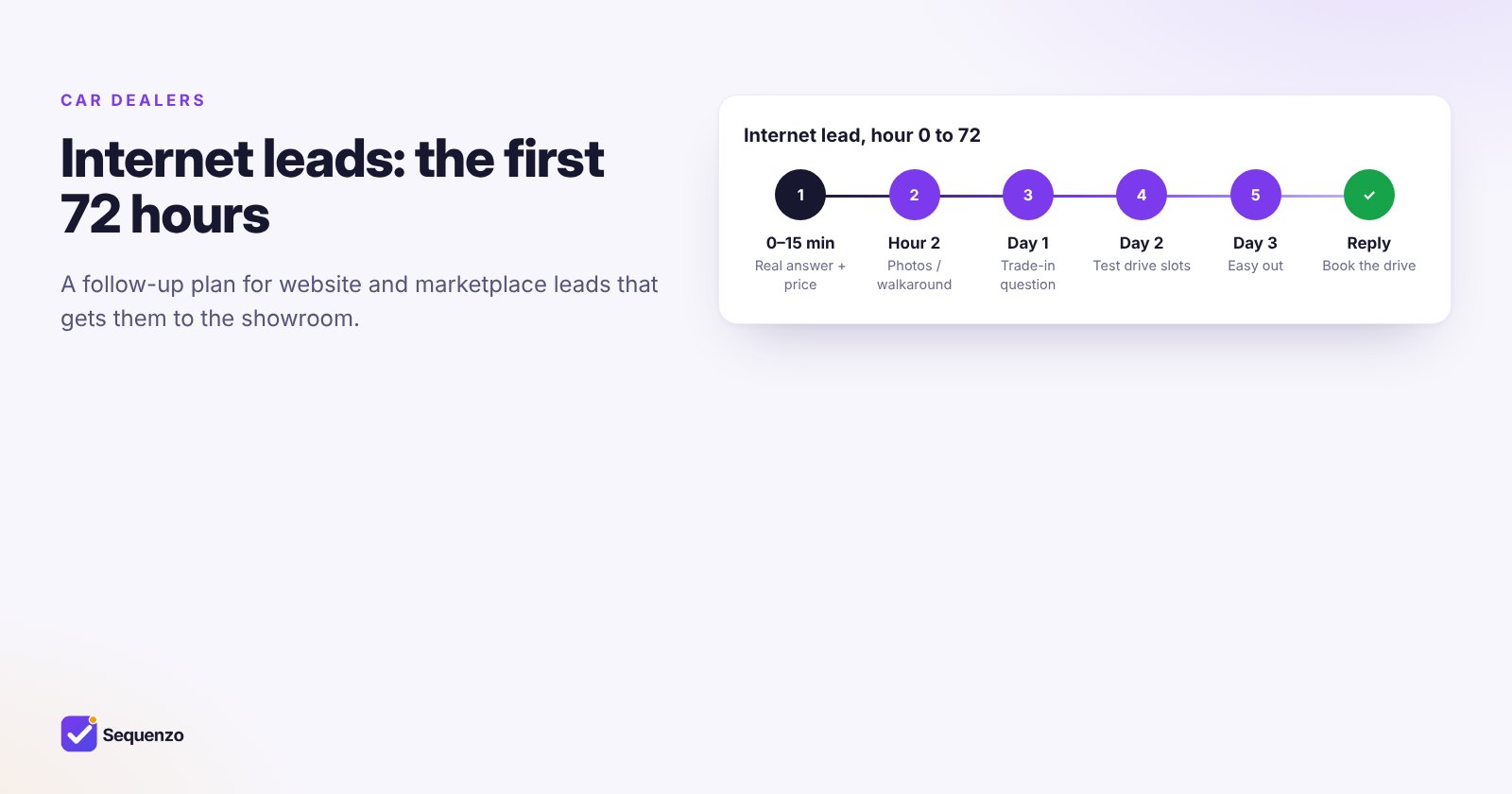
This is the 72-hour plan we'd suggest for website and marketplace leads.
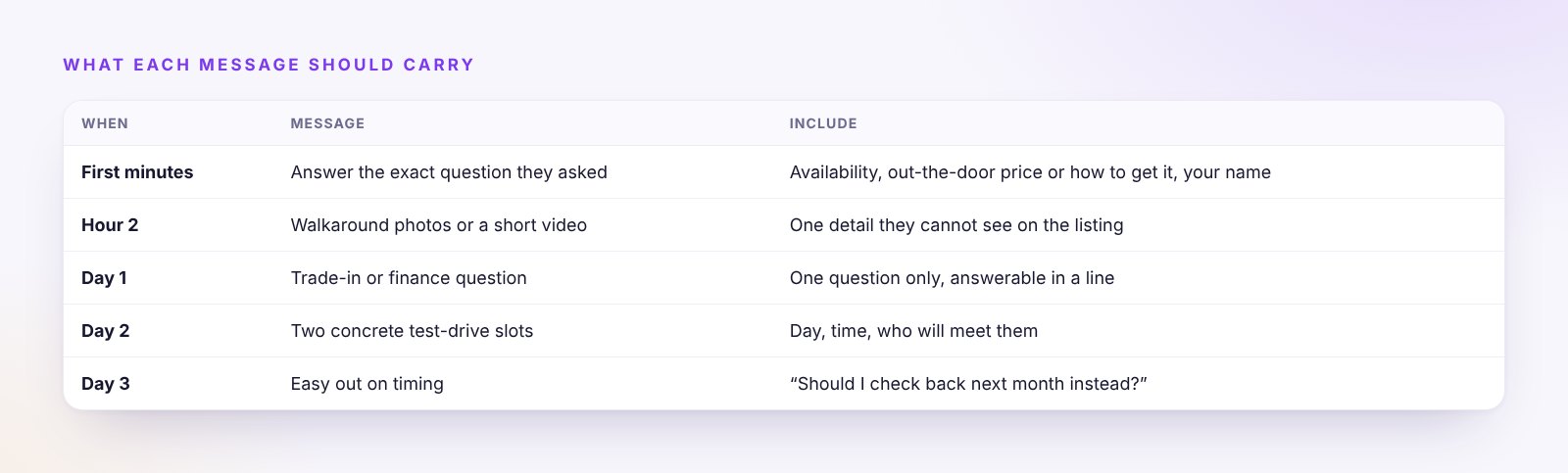
This plan is for salespeople, BDC teams and managers at new and used car dealerships handling leads from the dealership website, third-party marketplaces and manufacturer referrals. For buyers who have already driven the car, see car sales follow-up emails after a test drive.
The 72-hour plan at a glance
| When | Message | Job |
|---|---|---|
| 0 to 15 minutes | The answer they asked for | Availability, price route, a named person |
| Hour 2 | Walkaround video or photos | Show the actual car, flaws included |
| Day 1 | One question about trade-in or finance | Find the real obstacle |
| Day 2 | Two test-drive slots | Make visiting a one-word reply |
| Day 3 | The easy out | Let them say "not yet" |
| Weekly after that | Something new | Price change, similar stock, real offers |
Minutes 0–15: answer the question they asked
If they asked "is it still available?", the first line of your reply should be "Yes, it's here" (or "It sold yesterday, but we have two similar ones"). Then give them what they need to take the next step: the price or how to get an out-the-door figure, and your name.
"Hi Chris, yes, the blue 2023 RAV4 Hybrid is on the lot. It has 18,000 miles and one owner. I can send you the out-the-door price with taxes and fees for your zip code. What zip should I use? Thanks, Mia"
Write the first reply yourself, and fast. A templated "Thank you for your interest in our dealership!" that answers nothing is the most common way internet leads are lost. Our article on lead response time explains why minutes matter.
Hour 2: show them the car
"Here's a short walkaround video of the RAV4 I just took on the lot. You can see the tyres are almost new, and there's a small mark on the rear bumper I wanted you to see before you visit."
Pointing out a small flaw builds more trust than ten stock photos.
Day 1: one question about trade-in or finance
"Chris, will you be trading in a car? If you send me the make, model and rough mileage, I'll get you a trade-in range so you can see the real number."
One question, answerable in a line. Don't send a form with twelve fields.
Day 2: two concrete test-drive slots
"I can have the RAV4 ready for a test drive on Saturday at 10:00 or 14:00. I'll meet you myself, and it takes about 30 minutes. Does either work?"
Two real times get more replies than "let me know when you're free".
Day 3: the easy out
"Hi Chris, I don't want to fill your inbox. Are you still shopping, or should I check back next month instead?"
Buyers who went quiet often answer this one, because it lets them say "still looking, but not yet" without any awkwardness.
Replies to common internet-lead questions
"What's the lowest you'll go?"
"Hi Chris, the advertised price already includes [reconditioning / a warranty]. If you send me your zip and whether you're trading in, I'll give you an out-the-door figure in writing, and we can talk about the number from there."
"Is it still available?" when it has sold
"Hi Chris, that one sold yesterday, sorry. I have two similar ones: a 2022 with lower miles at a little more, and a 2023 in silver at about the same price. Want details on either?"
"Do you do home delivery?"
"Yes, within [area], and we can bring it for a test drive at your home too. Which day works best?"
"Can you hold it?"
"I can hold it until [day] with [a refundable deposit / your name on it]. After that, if someone else wants to drive it, I'll call you first."
Be specific and honest about holds and deposits. Buyers compare notes, and a hold that turns out not to exist ends the conversation.
Leads from marketplaces vs your own website
Marketplace leads have often contacted several dealers through the same form, so speed matters most there. Leads from your own website have already chosen you to some extent, and a detailed, helpful answer often matters more than shaving a few minutes. Both should get a personal first reply. Check whether each marketplace has its own rules about how and when you may contact the buyer.
After 72 hours
If there's still no reply, move to a slower rhythm: something new once a week for a few weeks (a price change, a similar car arriving, a finance offer that is actually available), then a polite close. See how to write the last follow-up.
After a test drive, the follow-up changes again. We cover that in car sales follow-up emails after a test drive.
Mistakes that send buyers to another dealer
- Not answering the question. "Come in and we'll talk numbers" when they asked for a price.
- Five people from the dealership emailing the same lead. One named person, one thread.
- Follow-ups after they replied or bought. Make sure follow-ups stop as soon as there's a reply.
- Unverified claims. Prices, availability and finance terms must be accurate and up to date.
Phone, text or email?
Many internet leads leave a phone number as well as an email address. Call once, soon after the enquiry, if the buyer asked for a call or the form suggests they want one. If they don't answer, don't call again and again; send the email that answers their question instead. Text only if they gave you their number for that purpose, and keep texts to practical details such as appointment times. Email is still the best place for prices, quotes and finance options, because the buyer will want to read them twice.
Measuring the plan
- Time to first personal reply, during opening hours.
- The share of internet leads that booked a test drive or visit within seven days.
- The share that got every step of the follow-up plan, rather than just the first reply.
The last number is often the most revealing. Many dealerships answer quickly and then stop, which wastes the effort of the fast first reply.
When the lead goes cold after a visit
Some internet leads come in, drive the car and then go quiet like any other buyer. At that point, switch them to your test-drive follow-up rather than continuing the internet-lead plan, so the emails talk about the car they drove and the numbers you discussed. The test-drive follow-up article has twelve emails for that stage.
A manager's weekly check
Once a week, pick five internet leads at random and read the whole thread. Did the first reply answer the question? Was there a walkaround video? Did the follow-ups go out, and did they stop when the buyer replied? Five threads tell you more about your process than any dashboard, and they give you real examples to coach from.
Running it across a sales team
The plan only works if it actually happens for every lead, including the ones that arrive on a busy Saturday. With Sequenzo, each salesperson sends from their own mailbox, picks the internet-lead flow in Gmail or Outlook when they send the first reply, and the next steps go out on schedule in the same thread. A reply stops the flow and creates a task. Managers can share the flow with the whole team. See email follow-ups for car dealerships.
Frequently asked questions
Q01How fast should a dealership respond to an internet lead?
As fast as possible, ideally within minutes during opening hours. Buyers often contact several dealers at once, and the first clear, specific answer has a strong advantage.
Q02What should the first reply to a car internet lead include?
A direct answer to their question (usually availability and price), the next step they can take, and the name of a real person. Avoid generic auto-responses that answer nothing.
Q03How many times should a dealership follow up with an internet lead?
Several times in the first 72 hours, each with a different purpose, then weekly for a few weeks if there is still no reply, and finally a polite close. Stop immediately when they reply.
Q04Should every salesperson use the same follow-up emails?
A shared plan keeps quality consistent, but each email should come from the salesperson's own mailbox and name so the buyer deals with one person in one thread.