On this page 11 sections
Every follow-up sequence needs an ending. The "breakup email" is the last message you send when someone has gone quiet: a short, polite note that says you are closing the loop and leaves the door open. It's often the email that finally gets a reply, because all it asks for is an honest answer.
This guide explains why it works, when to send it, a three-sentence structure, ten examples for different situations, and what to do with the replies you get.
This guide is for anyone running follow-ups on conversations they started: salespeople, agents, dealers, consultants, recruiters and small business owners. If you're emailing people who never asked to hear from you, a breakup email won't fix that, and the best thing to do is stop sooner.
Why the last email works
- It removes pressure. Earlier follow-ups ask for something. This one lets them off the hook, which makes replying feel easy.
- It gives them a decision to make. "Should I close this?" can be answered in one word.
- It respects their time, and people tend to remember that when they are ready.
Replies to a breakup email are often "not now, but try me in March" or "sorry, we went another way". Both are useful. The first gives you a date and the second lets you stop wasting effort.
When to send it
| Situation | Earlier follow-ups | Send the breakup email |
|---|---|---|
| Quote or proposal | Day 2, 6, 12, 16 | Around day 20 |
| Viewing or test drive | Day 1, 3, 7 | Around day 14 |
| Inbound lead that never replied | Day 1, 3, 7, 14 | Around day 30 |
| Long-term nurture (buyers months away) | Monthly | Around day 90 |
| Someone replied once, then went quiet | One or two nudges | After a week or two |
In most cases that's after four to six follow-ups spread over three to five weeks. Our follow-up cadence playbook walks through the spacing, and how long to wait before a follow-up covers the early steps.
The structure
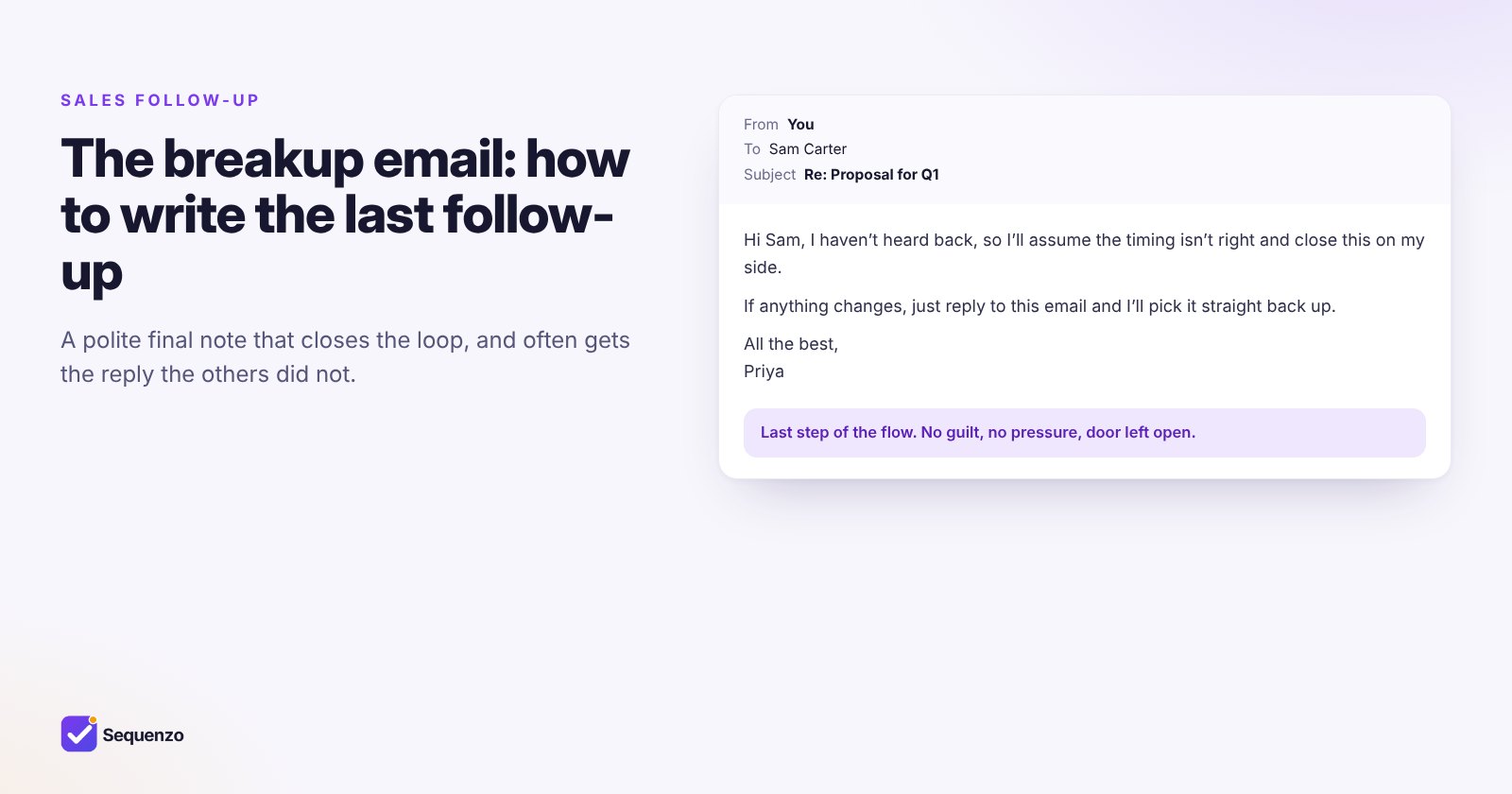
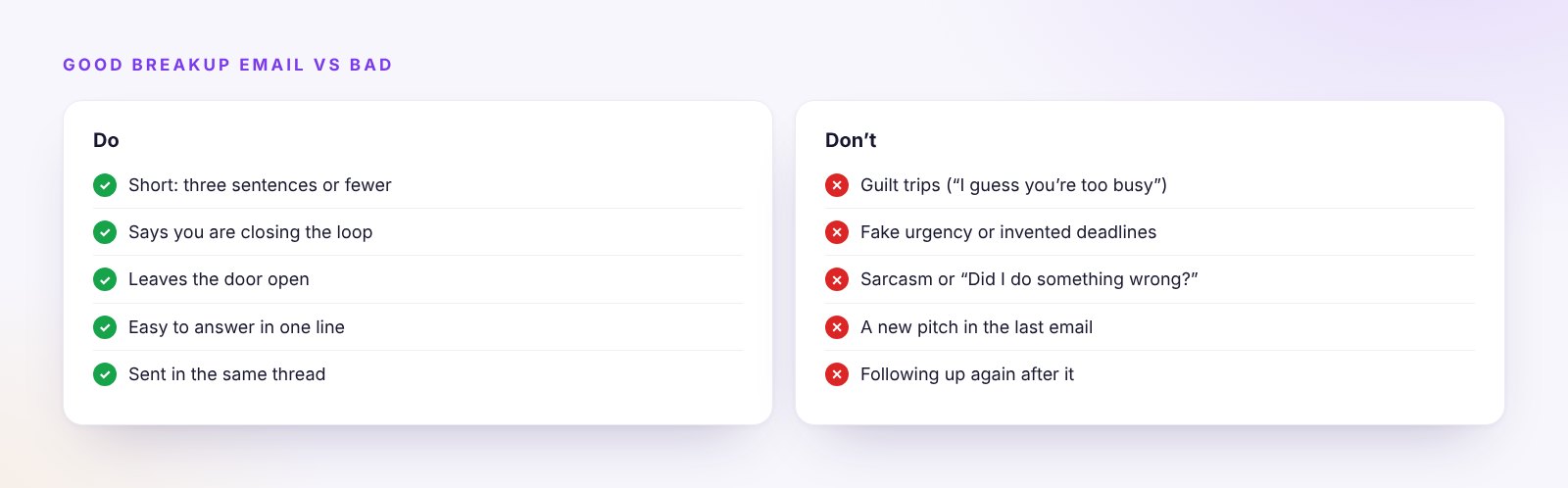
- Acknowledge the silence without blame: "I haven't heard back, so I'll assume the timing isn't right."
- Say what you'll do: "I'll close this on my side."
- Leave the door open: "If anything changes, just reply to this email."
That's three sentences, sent in the same thread so the whole history is there if they want it.
Ten breakup email examples
1. General sales
"Hi Sam, I haven't heard back, so I'll assume the timing isn't right and close this on my side. If anything changes, just reply here and I'll pick it straight back up."
2. After a quote
"Hi Dana, I'll take the fit-out quote off my list for now so I'm not filling your inbox. The price is held until the 28th if you'd like to go ahead; after that I'm happy to re-quote."
3. The one-word question
"Hi Alex, should I close your file, or is this still on the cards for spring? A one-word answer is perfect."
4. Real estate buyer
"Hi Jordan, it sounds like the search may be on hold, which is completely normal. I'll stop sending listings for now. When you're ready to start again, reply here and I'll send what's new in your area."
5. Real estate seller after a valuation
"Hi Sam, I won't keep chasing about the valuation. If you decide to sell later in the year, reply to this email and I'll update the figure with whatever has sold nearby since."
6. Car sales
"Hi Chris, I'll stop chasing about the RAV4 so I don't become that salesperson. If you're still looking later in the year, reply and I'll check what we have in."
7. Recruiter to a candidate
"Hi Aisha, I'll assume the Senior Accountant role isn't the right move for now and take you off the shortlist. If your situation changes, reply here and I'll tell you what's open."
8. Recruiter to a hiring manager
"Hi Mark, I haven't heard back about the shortlist, so I'll let the candidates know the role is on hold. If it opens up again, reply here and I'll check who is still available."
9. Invoice that is long overdue
"Hi Daniel, I've sent a few reminders about invoice #1042 and haven't heard back. Could you let me know who I should speak to about it? If it has been paid, please ignore this and accept my thanks."
For unpaid invoices, the "breakup" is a request for the right contact, not a goodbye. You still want to be paid.
10. Partner or referral
"Hi Maria, I know introductions take time, so I'll leave this with you. If it's ever useful, the offer stands."
What to do with the replies
- "Not now, try me in March." Thank them, note the date, and follow up then with something specific.
- "We went with someone else." Thank them and ask one question: what made the difference? Then stop.
- "Actually, yes, let's talk." Reply quickly with two times. The breakup email worked.
- "Please stop emailing me." Stop straight away, and make sure nothing else is scheduled for that address.
Weak breakup emails, rewritten
Most bad breakup emails come from good intentions and a bad week. Here are three common versions and a better rewrite of each.
The guilt trip
Before: "I've reached out several times and haven't heard anything. I'm guessing this isn't a priority for you, which is a shame given what we discussed."
After: "I haven't heard back, so I'll assume the timing isn't right and close this on my side. If it comes back on the agenda, just reply here."
The first version counts your emails and judges their priorities. The second says the same thing without blaming anyone, so it's much easier to answer.
The fake deadline
Before: "This is your LAST CHANCE to lock in this price. After today it's gone for good."
After: "The quote is valid until the 28th. After that I'm happy to re-quote, but materials may have gone up."
If the deadline is real, state it plainly. If it isn't, leave it out. A client who later finds the same price on offer next month won't trust your next deadline.
The new pitch
Before: "Before I go, I wanted to mention we've just launched three new features that I think you'd love..."
After: "I'll leave this with you for now. If you'd like to look again later in the year, reply and I'll send you what's changed."
The last email is for closing the loop. If you have news worth sharing, it deserves its own email at a sensible time later.
A checklist before you send it
- Is it three or four sentences at most?
- Does it say what you will do (close the file, stop sending listings) rather than what they failed to do?
- Is any deadline in it true?
- Is it in the same thread as the earlier emails?
- Is it really the last one? If you plan to keep emailing, it isn't a breakup email, so don't call it one.
Should you automate the breakup email?
Yes, as long as it is clearly the last step and everything stops when someone replies. Writing it once, calmly, usually produces a better email than writing it by hand at the end of a frustrating week. The risk with automation is a breakup email that goes out after the person has already answered, so check that your tool looks for replies right before each send as well as during the day.
What not to do
- Guilt trips such as "I guess you're too busy for this." It reads as passive-aggressive.
- Invented deadlines like "This offer disappears tonight" when it doesn't.
- Sarcasm or jokes about being ghosted. They age badly in a forwarded email.
- A fresh pitch. The last email isn't the place for new features.
- Following up after the breakup email. If you said you'd close it, close it.
After the breakup email
Closing the loop doesn't mean forgetting the person. Keep a simple list of everyone who said "not now" or didn't answer the last email, with the date and what they were interested in. Every three months, look through it. Some of those people will have a reason to hear from you again: a price change, a new listing in their area, a new model arriving, or a role that matches what a candidate wanted.
When you do get back in touch, start a new email with a specific subject rather than reviving a months-old thread, and say why you're writing: "We spoke in March about the fit-out. Material prices have dropped since, so I can quote lower if it's back on the table." One relevant email every few months is welcome. A monthly "just checking in" isn't.
Building it into a sequence
In Sequenzo, the breakup email is just the last step of a flow. If the person replies at any point before it, including to the breakup email itself, the flow stops and the conversation is yours. See how stop-on-reply works, or the free follow-up email templates for more last-email wording.
Frequently asked questions
Q01What is a breakup email in sales?
It is the last follow-up you send when someone has gone quiet. It politely says you will close the conversation on your side and leaves the door open for them to reply later.
Q02Do breakup emails really get replies?
They often do, because they ask for very little. A simple "should I close this?" is easy to answer, and many people reply to say the timing is wrong or to restart the conversation.
Q03Is a breakup email rude?
Not if it is short, polite and free of guilt or sarcasm. It respects the other person's time by stopping the follow-ups.
Q04Should I follow up after a breakup email?
No. If you said you would close the conversation, keep your word. If they reply later, pick it back up then.