On this page 11 sections
Homeowners usually get more than one estimate, and they often book whoever gets back to them properly. If you're on the tools all day, following up means evenings at the laptop, so a lot of estimates never get a second email. That's where jobs are lost: not to a cheaper quote, but to silence.
This guide is about following up on estimates for home services and trades: what to send, when, and how to handle the customer who thinks the price is too high. There's a timing table and ten templates you can use straight away.
This guide is for contractors, builders, plumbers, electricians, roofers, landscapers, cleaners and other home-service businesses following up with customers who asked for an estimate. Most of it works for small commercial jobs too.
Why estimates go quiet
- The customer is waiting for the other quotes before deciding.
- The price is higher than they hoped, and they'd rather say nothing than argue.
- They aren't sure what's included, especially compared with a cheaper quote.
- They're waiting on a partner, a landlord or their own finances.
- The job isn't urgent, so it keeps getting pushed back.
The timing at a glance
| Day | What it does | |
|---|---|---|
| 0 | The estimate | Price, what's included, how long it's valid |
| 2 | Any questions? | Invites the questions people don't ask |
| 5 | A start date | Gives a real reason to decide |
| 8 | A cheaper option | Answers a price concern without a discount |
| 14 | Close the loop | Lets them say "not now" |
| After the job | Thank you, then a review request | Builds the reputation that wins the next quote |
What to put in the estimate email
A complete estimate saves several rounds of questions. Put these in the body of the email, as well as in the attachment:
- The total, and whether tax is included.
- What's included and what isn't, in plain words.
- How long the price is valid.
- The earliest start date and roughly how long the job takes.
- How to accept: "reply 'yes' and I'll send the booking details".
Ten estimate follow-up templates
1. The estimate
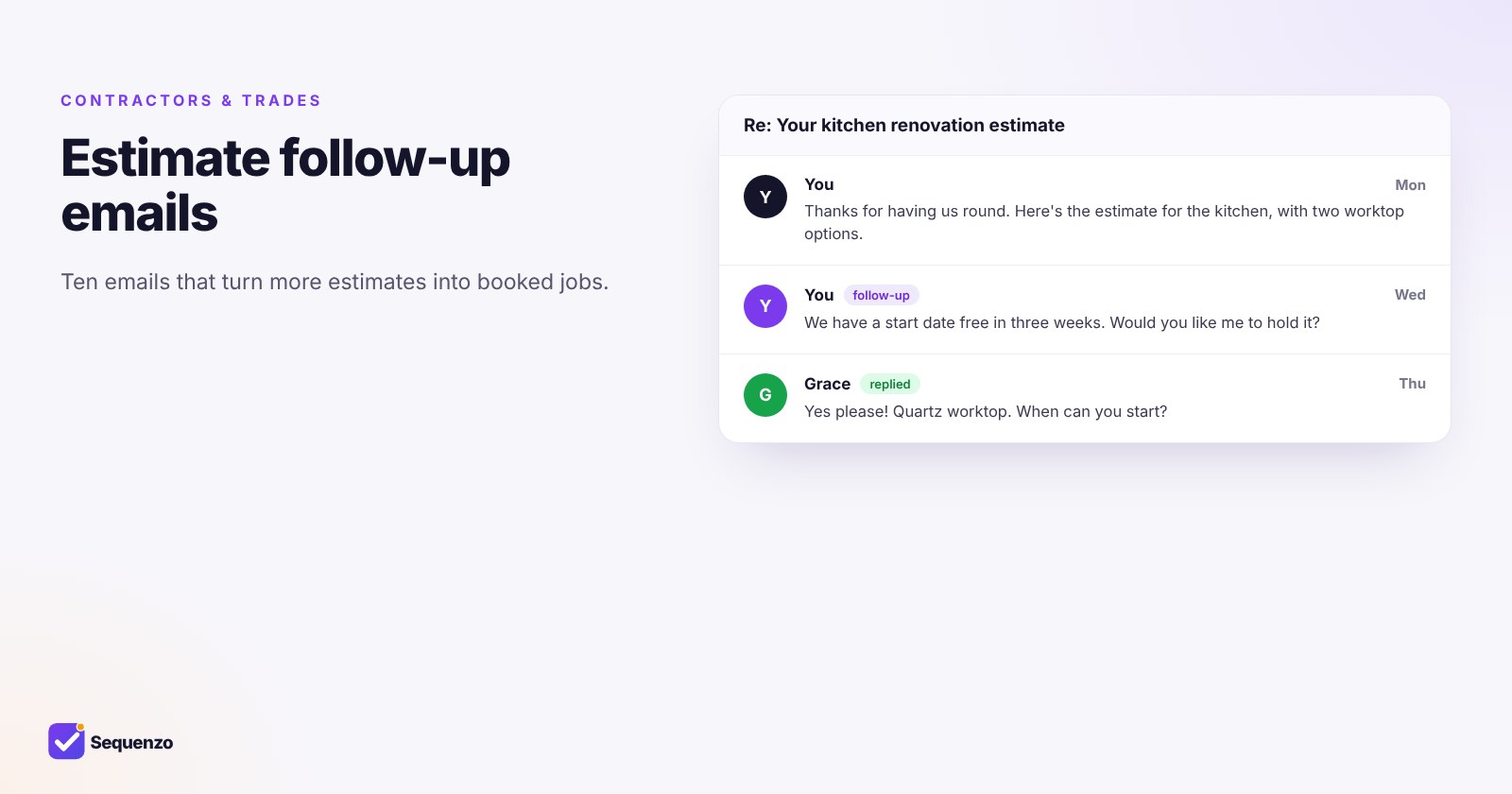
"Hi Grace, thanks for having us round. I've attached the estimate for the kitchen with the two worktop options we discussed. It's valid for 30 days. If you have any questions, just reply."
2. Any questions? (day 2)
"Hi Grace, did the estimate make sense? I can explain any line on it, or price up a simpler option."
3. What's included
"One thing people often ask: the price includes removing the old units, all the electrical work, and leaving the room clean. If you're comparing quotes, it's worth checking the others include the same."
4. A start date (day 5)
"We have a start date free on the 14th. Would you like me to hold it for you?"
A real date persuades people better than any sales line. Only offer one you can keep.
5. A cheaper option (day 8)
"If the total is more than you planned, we could use the laminate worktop instead of quartz, which brings it down by about $1,200. Or we could do the units now and the tiling later. Would either help?"
6. Close the loop (day 14)
"I'll close this estimate for now. If you want to go ahead later, reply and I'll check when we're free."
7. Site visit confirmation
"Hi Grace, just confirming we're coming to measure up on Thursday at 10am. It takes about 30 minutes. If anything changes, reply here."
8. The day before the job
"Hi Grace, we're starting tomorrow at 8am. Could you clear the worktops and make sure we can park on the drive? Any questions, call me on the number below."
9. After the job
"Thanks for having us, Grace. I hope you're enjoying the new kitchen. If anything isn't right, reply and we'll come back and sort it."
10. Review request (a week later)
"If you're happy with the work, would you leave us a short review? It helps other people find us. Here's the link: [review link]. Thank you."
Handling "it's too expensive"
Most customers who think a quote is too high never say so. When one does, it's an opportunity. Ask what they're comparing with, and check like for like: materials, guarantees, clean-up and who's doing the work. Then offer options before cutting your rate: a cheaper material, a smaller first phase, or a later start date when you're quieter. If you do lower the price, change the scope as well, so the next customer doesn't expect the same discount for the same job.
Phone, text or email?
Many customers prefer a quick call, especially for bigger jobs. Ring once a day or two after sending the estimate, then follow up by email so the details are in writing. Text is fine for practical things like arrival times, if the customer gave you their number for that. If a customer answers by phone, stop the email follow-ups for them so they don't get a reminder about something you've just agreed.
Bigger jobs need a slower plan
An extension or a full renovation is a bigger decision than a repair. Customers may need planning permission, a mortgage or several weeks to think. Space follow-ups further apart (day 3, day 10, day 21, then monthly), and make each one useful: a similar job you finished, an answer about permissions, or a revised drawing.
Know your win rate
Count how many estimates you sent last month and how many turned into jobs. Then compare estimates that got follow-ups with ones that didn't. Most trades find the followed-up ones convert noticeably better, and the number gives you a reason to keep doing it in a busy month. The free lost revenue calculator shows what unanswered estimates are worth.
Seasonal reminders for past customers
Many trades have work that comes round every year: boiler services, gutter cleaning, gardens, air-conditioning checks. A short reminder to past customers at the right time of year brings back work without any marketing spend. "Hi Grace, it's been a year since we serviced your boiler. Would you like to book this year's? We have slots the week of the 10th."
Common mistakes
- Sending the estimate and never following up. Most of the work goes to whoever does.
- Discounting straight away instead of offering options.
- A vague validity date. "Valid for 30 days" gives people a reason to decide.
- Forgetting the review request. It's the cheapest marketing you'll ever do.
Following up while you're on site
Sequenzo for contractors and trades sends follow-ups like these from your own email address during business hours, while you're working, and stops as soon as the customer replies. You write the flow once and pick it when you send each estimate. The free quote generator and profit margin calculator help with the estimate itself. For more on quote follow-ups in general, see how to follow up on a quote or proposal.
Frequently asked questions
Q01How soon should a contractor follow up on an estimate?
About two days after sending it, then around day 5 with a start date and day 8 with a cheaper option, and close the loop around day 14.
Q02What if the customer says the price is too high?
Check what they are comparing with, then offer options before cutting your rate: a cheaper material, a smaller first phase or a later start.
Q03Should I follow up by phone or email?
Both work. A quick call a day or two after the estimate, then email so the details are in writing.
Q04When should I ask for a review?
About a week after the job is finished, once the customer has had time to enjoy the result.